



View Chapter:
Downloads:
Chapter 3
Characterising Recent Research
Our review identified approximately 250 papers employing quasi-experimental or experimental methods that examine the effects of forced displacement and the policies addressing this issue. The publication of these papers has grown exponentially between 2010 and 2024 (Figure 4).
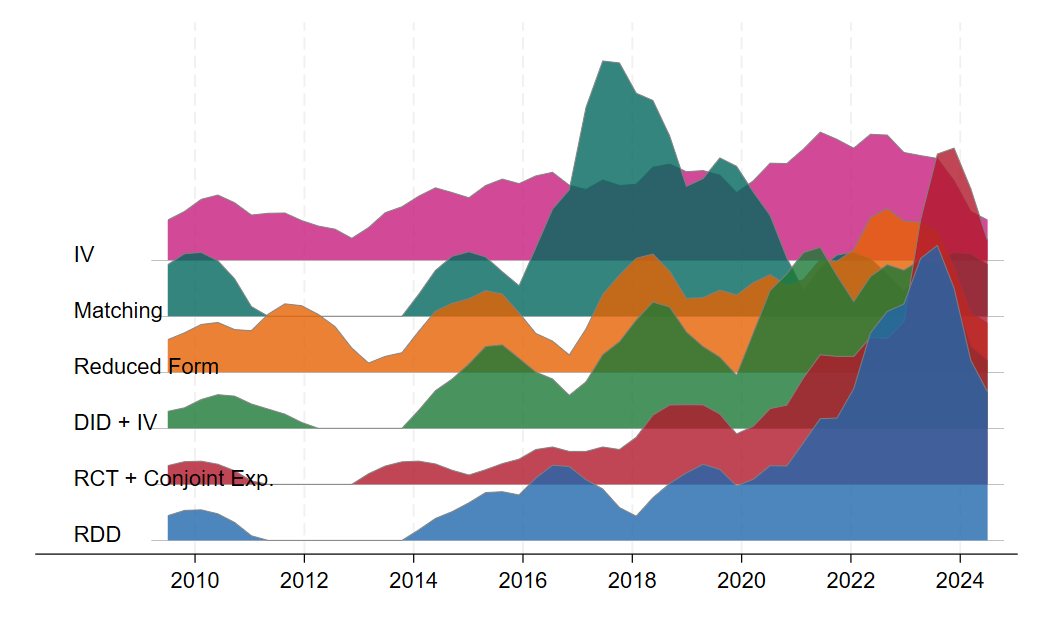
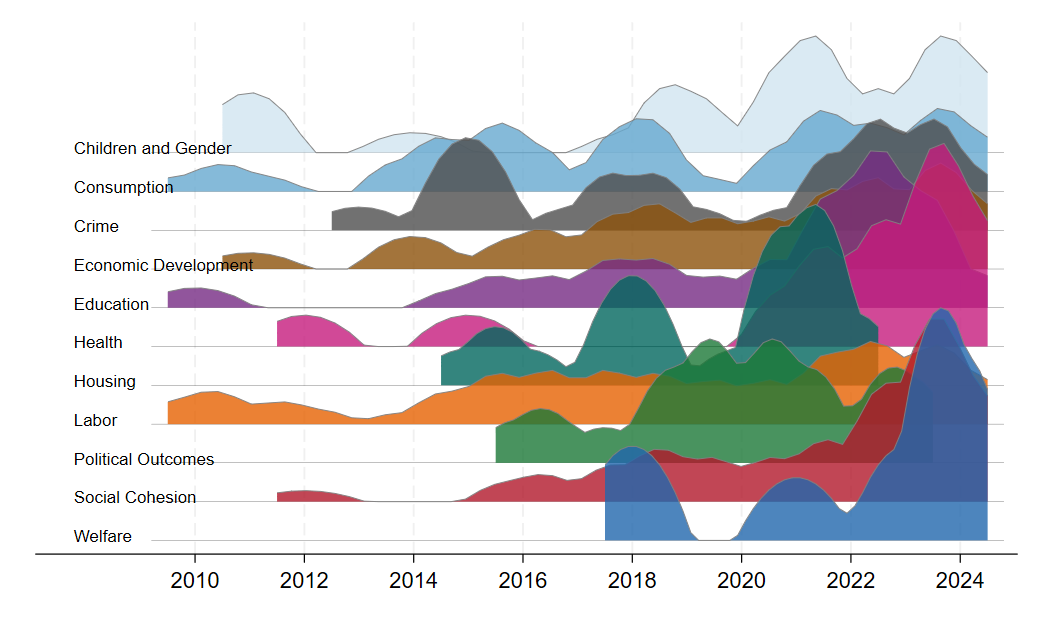
First, in terms of methodologies, there has been a notable shift from traditional approaches, such as matching, and reduced-form estimations, to more advanced techniques like difference-in-differences, randomised controlled trials (RCTs), and regression discontinuity designs (Figure 5). Moreover, instrumental variables have had a prominent role in this body of work throughout the period of analysis. This evolution reflects the growing rigour and precision in evaluating displacement impacts and policy interventions. Second, regarding research topics, some areas—such as labour markets—have remained consistently prominent.
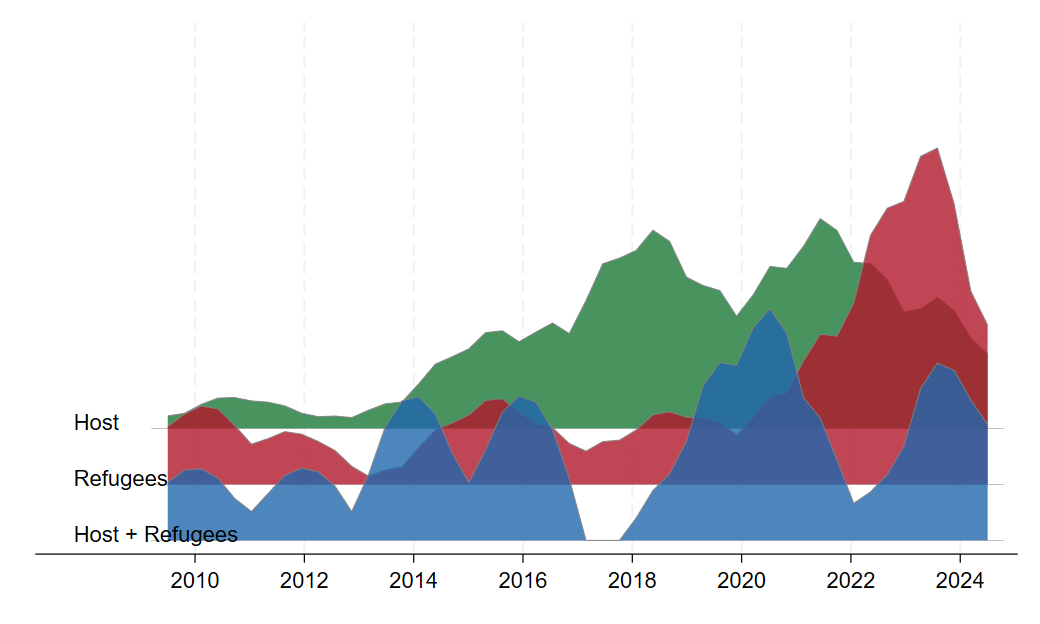
Finally, in terms of population focus, earlier studies primarily concentrated on the effects of forced displacement on host communities. More recent research, however, increasingly examines the experiences of forcibly displaced populations themselves, alongside the effectiveness of policies designed to support them (Figure 7). We classify these two bodies of work as first-generation and second-generation studies, respectively, and explore their main findings in the sections that follow.
Figure 5: Evolution of Research Methods in Forced Displacement Studies, 2010–2024
Panel A: Trends
Panel B: Cumulative
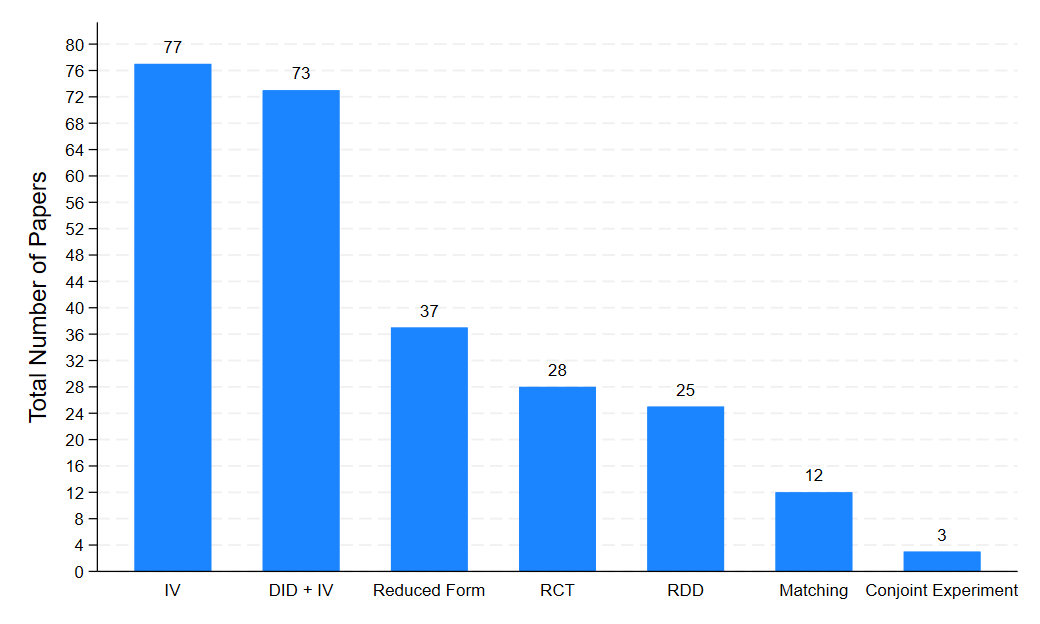
Notes: The figure displays the total number of studies published monthly from 2010 to 2024 that employ experimental or quasi-experimental approaches. Quasi-experimental methods include Difference-in-Differences (DiD), Instrumental Variables (IV), Matching techniques, Regression Discontinuity Designs (RDD), and Reduced Form analyses (using an exogenous proxy variable). Experimental methods refer to Randomised Controlled Trials (RCTs) and Conjoint Experiments.
Figure 6: Trends in Research Topics on Forced Displacement, 2010–2024
Panel A: Trends
Panel B: Cumulative
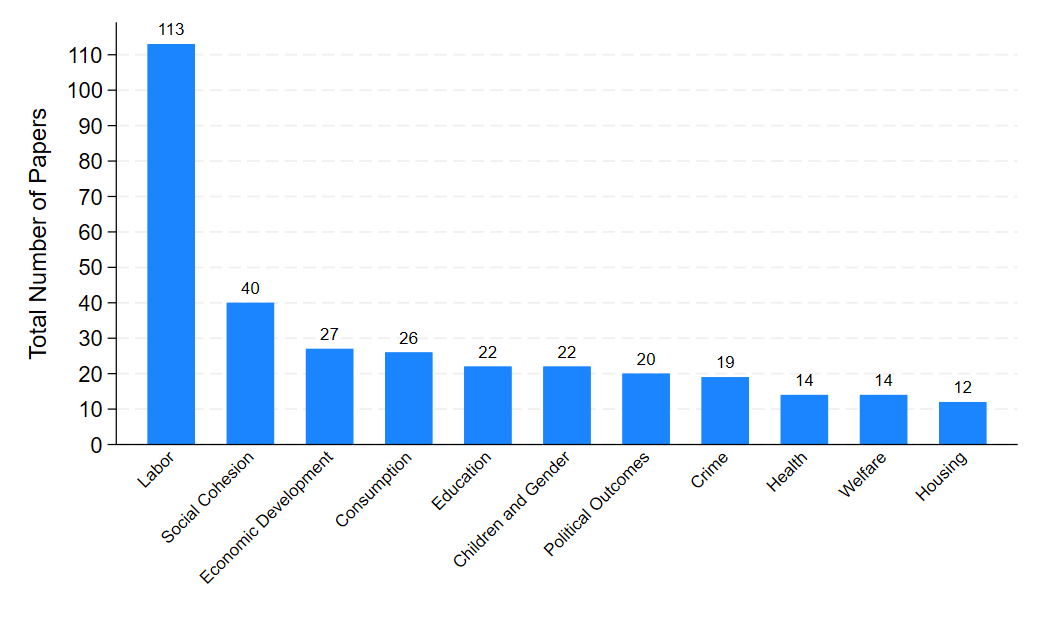
Notes: The figure illustrates the monthly distribution of studies from 2010 to 2024, categorised by primary topics. Children and Gender includes studies examining the impact of forced displacement on children and women. Consumption encompasses analyses of average consumption and food expenditure. Crime covers studies on crime rates, conflict recruitment, and arrests. Economic Development includes research on firm performance, firm creation and destruction, gross profit, net sales, business registrations, sectoral development, export and import performance, productivity improvements, business openness, patenting activity, infrastructure advancements (e.g. road improvements), environmental impacts (e.g. agricultural development, deforestation), and changes in night light density. Education includes studies on educational outcomes. Health captures effects on general health, healthcare access, and mental health. Housing considers housing prices, rent, and housing quality. Labour covers labour force participation, employment, wages, hours worked, and formal versus informal labour. Political Outcomes includes political participation, voting shifts for left, centre, and right parties, political competition, and party support changes. Social Cohesion examines attitudes toward refugees, government and migration, social exclusion, redistribution support, trust, reciprocity, altruism, migration intentions and patterns, anti-refugee violence, and xenophobic crimes. Welfare includes studies on poverty rates, financial and psychological well-being, self-reliance, access to services and subsidies, social protection systems, and quality of life. Some papers identify impacts on multiple topics; we include them under all the relevant topics they examine.
Figure 7: Population Focus on Forced Displacement Studies: Refugees vs. Host Communities, 2010–2024
Panel A: Trends
Panel B: Cumulative
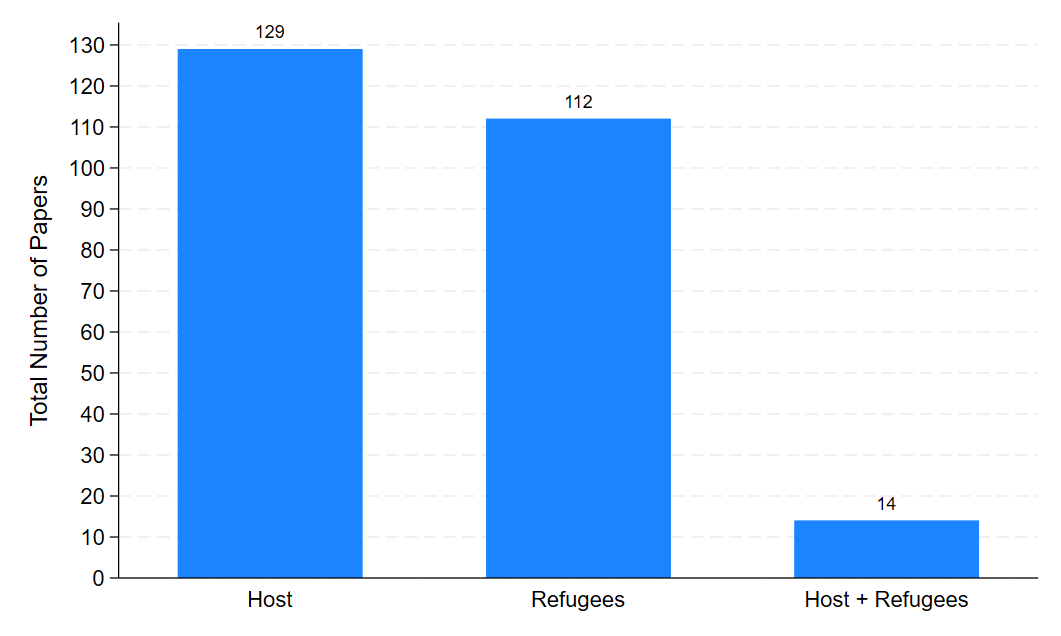
Notes: Panel A figure presents the monthly distribution of studies from 2010 to 2024, categorised by target population (host economy, host population, and refugees). Topics analysed in the host economy focus include crime, firm entry, firm performance, market structure, environmental impact, housing conditions, rental and housing prices, nightlight density, firm production margins, export performance, business formation, inflation, foreign trade, firm hiring decisions (especially regarding refugees), tax impacts, firm quality, and investment effects. Studies also cover licensed business revenues, agricultural productivity, deforestation, transport costs, household wealth, educational attainment, sectoral financial growth, total factor productivity, and labour market adjustments to supply and demand shocks. Research focusing on the host population addresses attitudes toward refugees, labour outcomes, xenophobic crime, welfare, and income diversification. In studies centred on refugees, topics include integration, fertility decisions, participation in local programmes, sectoral employment, poverty rate and overall quality of life. Panel B figure presents the total studies from 2010 to 2024, categorised by target population (host economy, host population, and refugees).
For full reference list see the end of the conclusion chapter.
Contact VoxDev
If you have questions, feedback, or would like more information about this article, please feel free to reach out to the VoxDev team. We’re here to help with any inquiries and to provide further insights on our research and content.