


When new manufacturing sectors emerge in developing countries, a significant share of the workforce is often comprised of women, many of whom previously lacked access to non-agricultural employment. Such employment can have important consequences for women’s physical and psychological wellbeing, as well as for resource allocation within households.
Editor’s note: For a broader synthesis of themes covered in this article, check out our VoxDevLit on Female Labour Force Participation.
The impact of female employment on intrahousehold dynamics in developing countries
Evidence on the intrahousehold effects of women’s low-wage manufacturing work is scarce. Analyses using causal identification strategies generally support a theory that an employment-induced rise in women’s bargaining power reduces intimate partner violence (IPV) (Sanin 2022, Grogan 2023, Uckat 2023). The bargaining power of women in households is closely linked to relative incomes of men and women (Bertrand et al. 2015). For instance, Aizer (2010) uses hospital admissions data to show that the long run narrowing of the gender wage gap in California reduced domestic violence by about 9% between 1990 and 2003. When employment improves a woman’s bargaining power enough, other systematic, countervailing effects of female employment on partnerships may not be detected.
In some countries, such as Lesotho, workers are protected by stronger labour laws and unions, and wages have been relatively high. In Central America, however, employment conditions in export-oriented manufacturing have long been largely unregulated, unionisation has been actively discouraged, and wages have remained very low. While the wages offered may be enough to attract a large pool of relatively less-educated women, the overall impact of this employment on their lives is not well-understood. In Grogan (2025), I investigate the impacts of very low-wage manufacturing employment for women in Nicaragua from 1998 to 2012, using detailed survey data designed to measure women’s health, wellbeing, and agency.
Trade liberalisation may sometimes have negative initial impacts on women’s home lives, as men’s loss of status in their households may be a powerful motivation for IPV (Eaten and Keskin 2021, Chong and Velasquez 2024). Research suggests that increases in women’s bargaining power from employment may be overshadowed by partners’ motivations to re-assert control over women, a ‘male backlash’ motive. As women’s incomes increase, new ‘instrumental’ incentives may emerge for partners to extract income. Where laws do not effectively protect women, these new incentives are unlikely to be tempered.
International firms have produced exports from Nicaragua under favourable tax and regulatory conditions since the mid-1990s. After the signing of the Central American Free Trade Agreement with the US in 2006, both foreign direct investment and employment of women in export processing zones (EPZs) increased substantially. The real value of exports also rose, as shown in Figure 1. A majority of new jobs created were in textile and apparel production, as they were in the first EPZs introduced in the 1970s under the pre-communist Somoza regime. These EPZs are exempt from much of Nicaraguan labour law.
Figure 1: Exports of goods, services and incomes from Nicaragua, 1990-2020
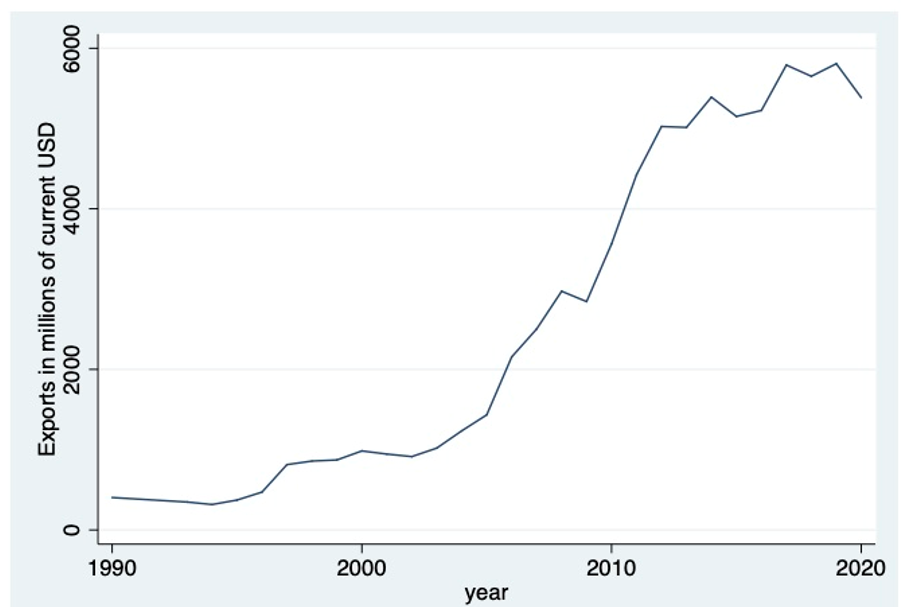
Source: World Development Indicators 2021, Nicaragua
Women’s employment in export processing zones can disrupt gender roles, contributing to intimate partner violence
In Nicaragua, the new employment in EPZs was primarily taken up by less-educated women, while women with secondary education were less likely accept such low-wage jobs. However, evidence suggests that these EPZs had minimal impact on poverty reduction in their early years (Picarelli 2016).
If women have traditionally provided time, and men money, towards home-produced goods and childcare, then female employment in EPZs may disrupt this domestic balance. In very poor contexts, where home production significantly influences living standards, such disruptions may be especially severe. Workdays also tend to be very long in EPZs. As such, partner’s incentives to try to access cash earned by women may increase, potentially resulting in extreme forms of non-cooperation such as IPV. Such behaviours may undermine the poverty-reducing impact of female employment by diminishing both the total household resources available and women’s influence over their allocation. Administrative data sources, such as locality-specific counts of female hospitalisations for suspected IPV injuries, are unlikely to shed light on such channels.
Using demographic and health surveys to study the impact of employment on intimate partner violence
A woman’s decision to work outside the home is likely influenced, at least in part, by her expectations of her partner’s response to the change.
The Demographic and Health Surveys and National Demography and Health Surveys, spanning the 1998 to 2012 rollout of EPZs, features data on employment, socioeconomic characteristics, and women’s interactions with their partners. This data comprises a wide range of questions on specific types of physical violence and threatening behaviour experienced by women aged 15 to 49, including those related to partner’s excessive drinking, demonstrated jealousies, and other types of controlling behaviours.
Studying the impact of export processing zones on female employment
In Nicaragua, the timing of EPZ arrival by municipality is well-documented, as municipalities had to seek approval from the National Commission of Export Processing Zones to enter into agreements with export-oriented firms granted free trade status by the government. This time-varying rollout of EPZs is depicted in Figure 2.
Figure 2: EPZ rollout across municipalities of Nicaragua
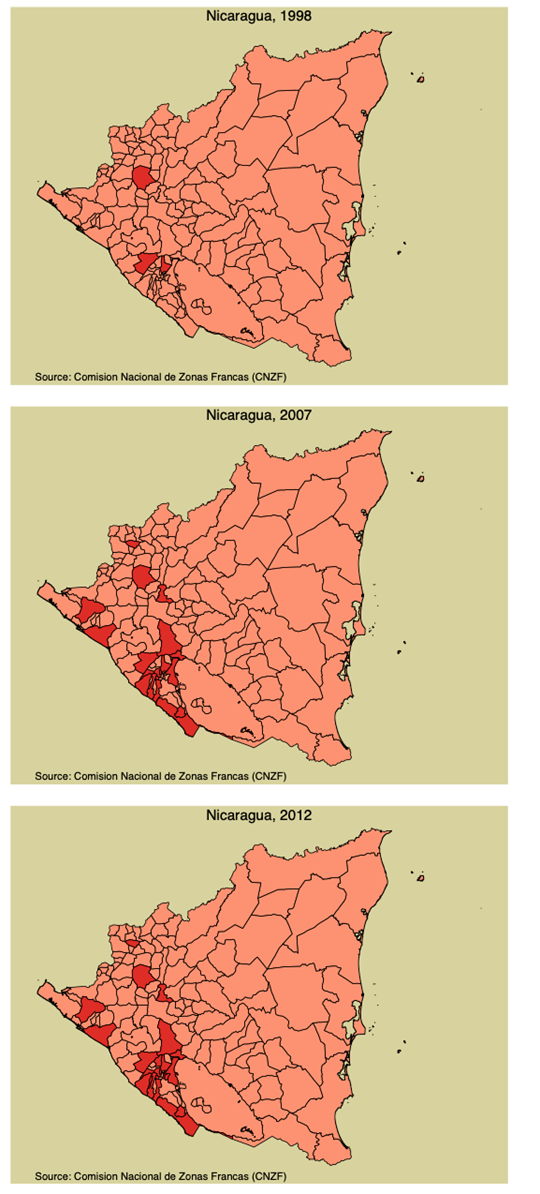
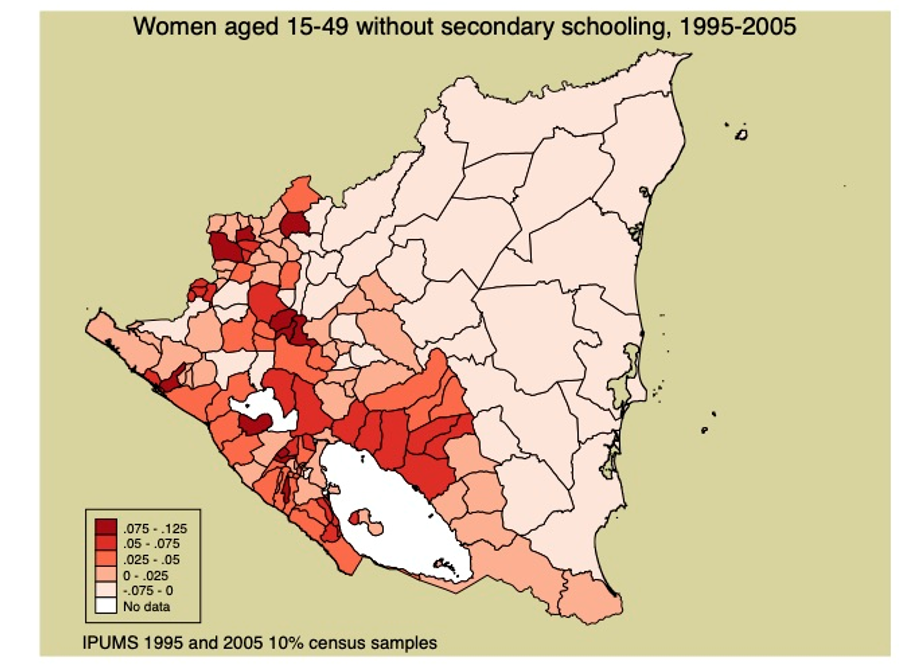
EPZ recruitment practices meant that arrival in a municipality affected employment of less, rather than more, educated women. This can be leveraged to distinguish between the general local impacts of EPZ presence on households, and those effects that arise specifically through employment in EPZ work. The 1995 and 2005 Nicaragua census samples from IPUMS International (Minnesota Population Center 2020) also show that the employment of women without secondary education increased the most in western Nicaragua, where the EPZ sector emerged.
Figure 3: Non-agricultural employment rate changes
Export processing zones increased intimate partner violence in Nicaragua
We found that IPV is found to causally increase as a result of this new factory work, with male backlash and resource extraction emerging as key channels. Controlling behaviours increased significantly following women's EPZ employment, and partners became more likely to come home drunk at least once per week. While EPZs expanded women’s earning potential, they may have also broken an implicit contract between women and men in the household.
Policy implications for employment and gender norms
Improved employment standards, worker training, and wages may be key to ensuring that job prospects strengthen Nicaraguan women's bargaining power within partnerships. In some countries, such as Bangladesh and Lesotho, jobs in new textile factories appear to have primarily been obtained by relatively well-educated women. The emergence of these factories incentivised parents to invest in their daughters’ education, preparing them for lucrative new opportunities in non-agricultural work (Heath and Mobarak 2015).
EPZ investments in worker productivity may improve home lives while also reducing production lost to IPV. As women's earning prospects increase, they may be able to increase their financial contribution to household public goods while reducing their time commitments within the home. Outside options may also improve. Sufficient improvements in wage employment possibilities may then eventually reduce instrumental motives for violence.
Governments hosting EPZs may be incentivised to improve these standards if foreign investors are held to account by shareholders and governments in their country of origin. Whereas gender norms and legal protections may change slowly, the regulation of employment conditions may more quickly increase the ability of Nicaraguan women to realise bargaining power gains from manufacturing work.
References
Aizer, A (2010), “The gender wage gap and domestic violence”, American Economic Review, 100(4): 1847–1859.
Bertrand, M, E Kamenica, and J Pan (2015), “Gender identity and relative income within households”, Quarterly Journal of Economics, 130: 571–614.
Chong, A and D Velásquez (2024), “Does trade liberalization foster intimate partner violence?”, Economic Development and Cultural Change, 72(2): 563–602.
Eaten, B and P Keskin (2021), “Trade-offs? The impact of WTO accession on intimate partner violence in Cambodia”, Review of Economics and Statistics: 1–40.
Grogan, L (2023), “Manufacturing employment and women’s agency: Evidence from Lesotho 2004–2014”, Journal of Development Economics, 160: 1029–1051.
Grogan, L (2025), “Employment without empowerment: Low-wage manufacturing and intimate partner violence in Nicaragua, 1998–2012”, World Development (forthcoming).
Heath, R and M Mobarak (2015), “Manufacturing growth and the lives of Bangladeshi women”, Journal of Development Economics, 115: 1–15.
Minnesota Population Center (2020), "Integrated Public Use Microdata Series, International Version 7.3: Nicaragua 1995 and 2005", IPUMS.
Picarelli, N (2016), “Who really benefits from export processing zones? Evidence from Nicaraguan municipalities”, Labour Economics, 41(1): 318–332.
Sanin, D (2022), “Paid work for women and domestic violence: Evidence from the Rwandan coffee mills”, Unpublished manuscript.
Uckat, H (2023), “Leaning in at home: Women’s promotions and intrahousehold bargaining in Bangladesh”, World Bank.