




Air conditioning adoption in Mexico has grown much faster than earlier forecasts, with nearly one million more units installed than predicted, largely due to falling electricity prices and rising energy efficiency that lowered the cost of cooling.
Editor’s note: For a broader synthesis of themes covered in this article, check out our VoxDevLits on Climate Adaptation and Electricity Infrastructure. The authors have made slides available to accompany their research here.
A common theme in the vast evidence on climate change is to estimate models using historical data in order to make predictions many decades into the future (e.g. Deschênes and Greenstone 2011, Burke et al. 2015). Despite the growing number of these studies, researchers rarely verify whether their predictions prove accurate.
Our new research (Davis and Gertler 2025) performs such an exercise. We previously used data from Mexico in 2010 to predict future air conditioning adoption (Davis and Gertler 2015). At the time we wrote that “[t]he use of air conditioning is poised to increase dramatically over the next several decades as global temperatures go up and incomes rise around the world”. Now, with the benefit of 12 years of additional data, we revisit these predictions to assess how well we did. We find that not only has air conditioning adoption accelerated rapidly, but significantly exceeded our predictions.
This is a big deal. Air conditioning offers tremendous comfort and saves lives during heat waves (Barreca et al. 2016). But it is also much more energy intensive than other climate adaptation technologies. Even a modest room air conditioner can consume 1,000 watts, compared to the 50 to 80 watts used by a ceiling fan. Air conditioning is thus the single largest driver of future global electricity demand, surpassing even data centres (IEA 2024). We document this acceleration but also ask why this is happening.
Air conditioner adoption has exceeded predicted levels
Figure 1 compares our predictions (x-axis) with the actual level of air conditioning in Mexico in 2022 (y-axis). The underlying data and modelling use household-level data, but for the purposes of the figure we aggregate up to state-level. If our predictions were perfect, then all observations would be along the 45° line (in orange).
Figure 1: Predicted vs. actual air conditioning adoption
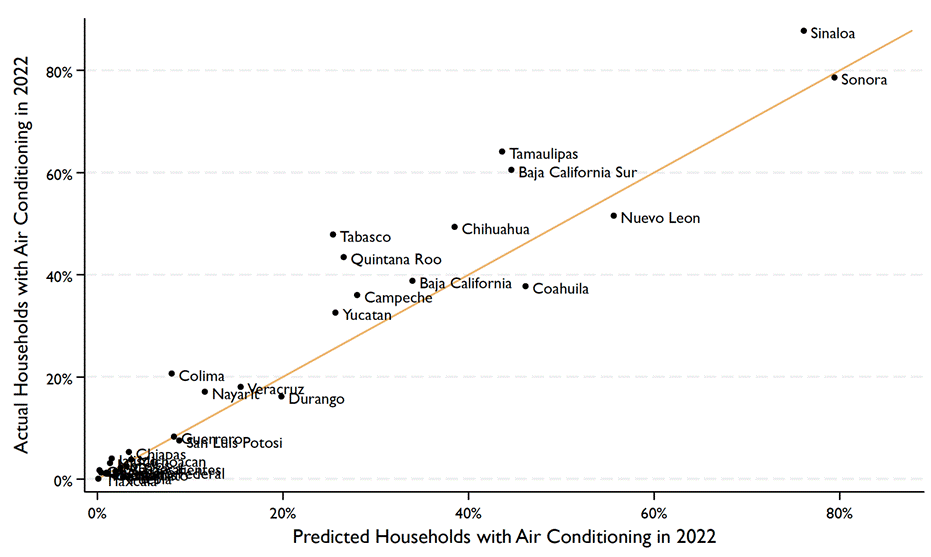
We underpredicted air conditioning in most states. The prediction gap is widespread, but particularly pronounced in warm states like Tabasco, Quintana Roo, Tamaulipas, and Baja California Sur – all well above the 45° line.
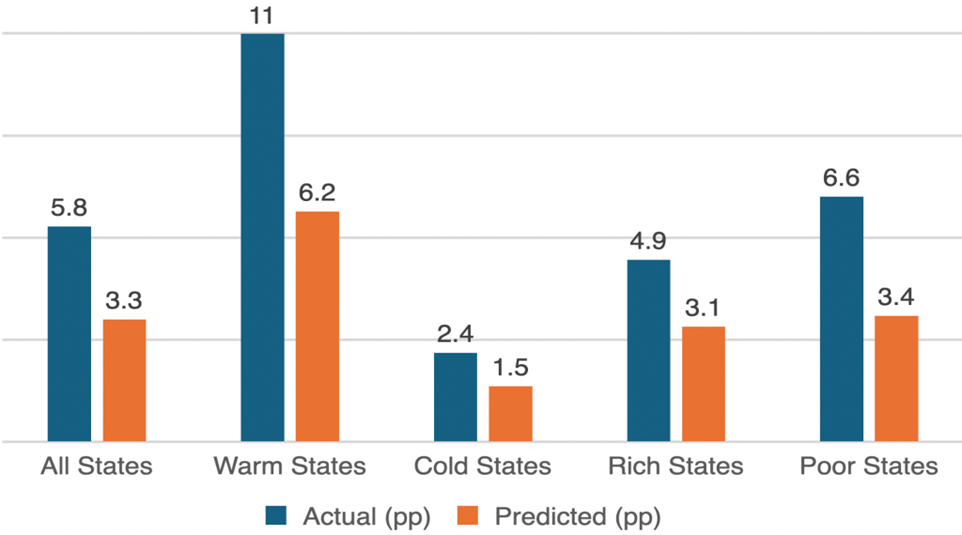
Looking at growth in air conditioning makes the prediction gap clearer. As Figure 2 shows, air conditioning in Mexico increased 5.8 percentage points between 2010 and 2022 – whereas we had only predicted a 3.3 percentage point increase. In warm states, this growth was 11 percentage points; our prediction was around half that (6.2 percentage points).
Figure 2: Growth in air conditioning ownership (2010-2022)
Exploring potential explanations for the ‘prediction gap’
What explains the prediction gap?
- Did income grow more than expected? Our previous research emphasised household income as a primary determinant of air conditioning adoption. We have since found that household incomes in Mexico have grown less than we assumed in our predictions – incorporating updated information thus widens the prediction gap rather than narrowing it.
- Did temperatures increase more than expected? Like almost everywhere else, Mexico is growing hotter, and this leads more households to adopt air conditioning. However, we find that our assumptions about temperature growth were quite accurate and cannot explain the prediction gap.
- Did households migrate to warmer locations? Another hypothesis we considered is migration within Mexico towards warmer locations. But when we look at the data, we find that this effect is too small to matter.
- Was our original model too inflexible? Using data from our previous research, we estimated a more flexible machine learning (ML) model. Though it did improve performance slightly, a large prediction gap persists.
Thus, none of these four hypotheses can explain the prediction gap.
Lower energy prices drive air conditioner use
Striking out with several hypotheses, we went back to first principles. Economists have long pointed out that demand for energy is derived from energy services, such as cooling (Hausman 1979, Dubin and McFadden 1984). At the end of the day, it isn’t the air conditioner itself that makes someone happy – it’s the cooling.
Viewed through this lens, it makes sense to ask if there has been any change in the price of cooling. Collecting additional data, we show that residential electricity prices in Mexico fell by 19% in real terms between 2010 and 2025 (Figure 3).
Figure 3: Electricity prices in Mexico
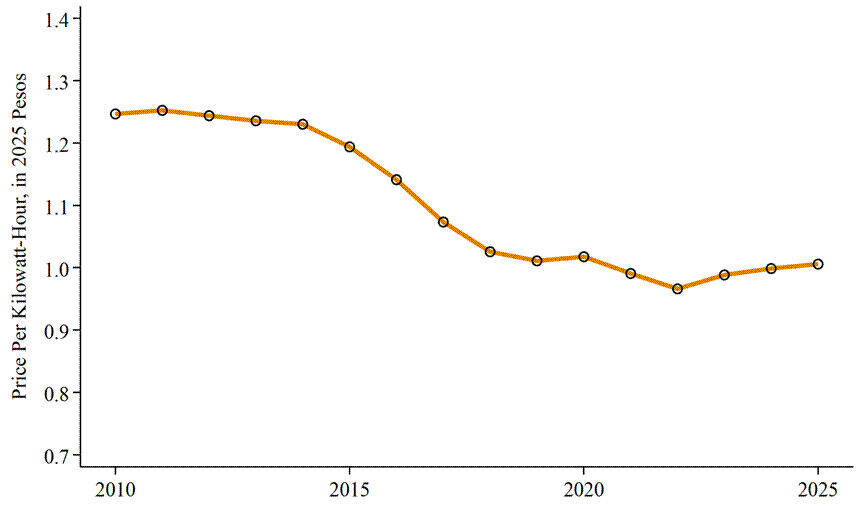
By the end of the period, Mexico had some of the lowest electricity prices in the world, equivalent to US$0.05 per kilowatt hour, compared to the US national average of over $0.17 (EIA 2025). These low prices motivate households to use more electricity.
In addition, the energy efficiency of air conditioning has continued to improve (Figure 4). Between 2010 and 2025, there was an 11% increase in energy efficiency.
Figure 4: Energy efficiency of air conditioners
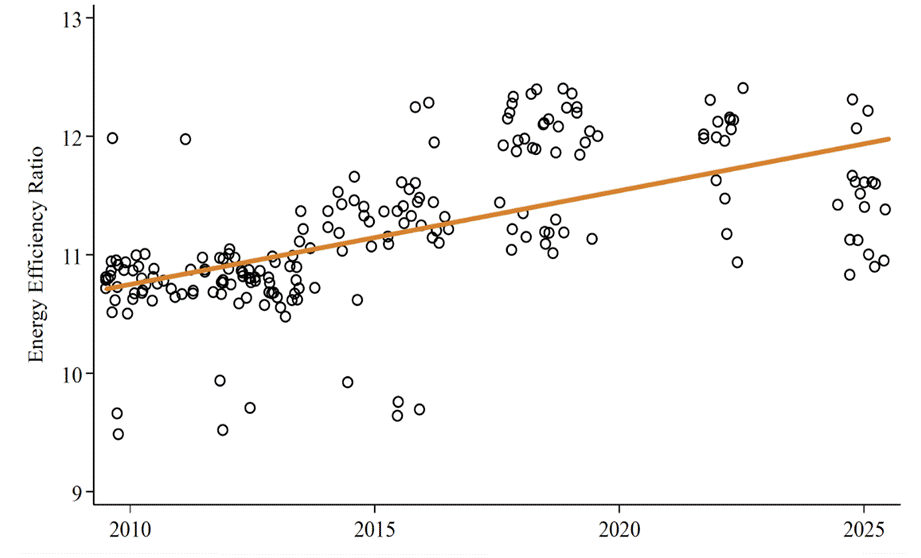
Note: Energy efficiency ratio is measured in BTU (of cooling output) per watt (of electricity input). These data were compiled from US based Consumer Reports magazine. We would have preferred data from Mexico, but we are not aware of any comparable data source from Mexico and most of the air conditioners profiled by Consumer Reports are manufactured in China and Southeast Asia by companies that export to both the US and Mexico.
Putting both factors together implies that the cost of cooling has decreased 30% from 2010 to 2025. Using price elasticity estimates from prior research and the change in income elasticities over time from the Engel curves estimated from our data, we argue that the fall in the price of cooling is large enough to explain most of the acceleration in air conditioning adoption.
Implications for climate and energy policy
Just 12 years since we made our original predictions, there are already nearly one million more air conditioners in Mexico than we predicted. If this accelerated pace of adoption continues, it will mean near ubiquitous air conditioning in Mexico more than a decade earlier than we forecasted.
Meeting this increased demand for electricity will require large investments in generation and transmission. Mexico already faces blackouts during heat waves – further stretching an already strained grid. Since most electricity in Mexico comes from fossil fuels, greater reliance on air conditioners will also translate into increased emissions.
More broadly, our research provides a cautionary tale for the growing number of climate change predictions based on temperature and income alone. These factors are undoubtedly important, and we still need much more research on both. Our findings serve as a valuable reminder that prices and technological change matter too. In short, predictions of energy use and its impacts will only be credible if they clearly account for how prices and energy efficiency are expected to change. Looking back, this would not have been easy. We may have been able to predict improvements in energy efficiency based on recent trends, but not the decrease in electricity prices.
References
Barreca, A, K Clay, O Deschênes, M Greenstone, and J S Shapiro (2016), “Adapting to climate change: The remarkable decline in the U.S. temperature-mortality relationship over the twentieth century,” Journal of Political Economy 124(1): 105–159.
Burke, M, S M Hsiang, and E Miguel (2015), “Global non-linear effect of temperature on economic production,” Nature 527(7577): 235–239.
Davis, L W, and P J Gertler (2015), “Contribution of air conditioning adoption to future energy use under global warming,” Proceedings of the National Academy of Sciences 112(19): 5962–5967.
Davis, L W, and P J Gertler (2025), “Why did air conditioning adoption accelerate faster than predicted? Evidence from Mexico,” NBER Working Paper.
Deschênes, O, and M Greenstone (2011), “Climate change, mortality, and adaptation: Evidence from annual fluctuations in weather in the U.S.,” American Economic Journal: Applied Economics 3(4): 152–185.
Dubin, J A, and D L McFadden (1984), “An econometric analysis of residential electric appliance holdings and consumption,” Econometrica 52(2): 345–362.
Energy Information Association (EIA) (2025), “Table 5.6.A. Average price of electricity to ultimate customers by end-use sector.”
Hausman, J A (1979), “Individual discount rates and the purchase and utilization of energy-using durables,” Bell Journal of Economics 10(1): 33–54.
Garcia, D A, and A Barrera (2025), “Mexico heat wave triggers ‘exceptional’ power outages, president says,” Reuters.
International Energy Agency (IEA) (2024), “World energy outlook.”