



India’s IT boom generated large but unequal gains, and shows why education access and mobility determine who gains from high-skill globalisation.
Editor’s note: For a broader synthesis of themes covered in this article, check out Issue 2 of our VoxDevLit on International Trade. The author has made slides available here.
India’s IT boom is often told as a success story of globalisation. A sudden rise in global demand for software services created jobs, raised exports, and helped transform India into a major supplier of high-skill services. But the gains were not evenly distributed across space. Some districts became major IT hubs, while others benefited much less.
Why did the same national trade boom generate such unequal local gains? And what policies could make those gains more widely shared? The answer is not only about where firms and jobs are located. It is also about whether people can acquire the skills needed to access those jobs. This speaks to a broader point in recent discussions on trade and development: the largest gains from trade often come through dynamic channels such as learning, technology adoption, and human capital accumulation, rather than static reallocation alone (Goldberg and Ruta 2025).
Between 1998 and 2008, India’s IT share of total service exports rose from 15% to 40%, while engineering enrolment more than doubled. Y2K and the dot-com boom sharply increased demand for Indian software services, and since more than 80% of India’s IT output was exported, this greatly expanded domestic demand for engineers. Yet districts varied sharply in their ability to respond: some already had engineering colleges, English-speaking populations, and early IT firms; others were far from higher-education institutions or major labour markets.
Trade shocks increased both jobs and education
Districts more exposed to the IT boom experienced larger increases in both IT employment and engineering enrolment. Employment responded quickly after the export shock. Enrolment rose with a lag, consistent with students investing in engineering degrees in response to new labour-market opportunities.
Figure 1: Trade shocks increased both IT jobs and engineering enrolment
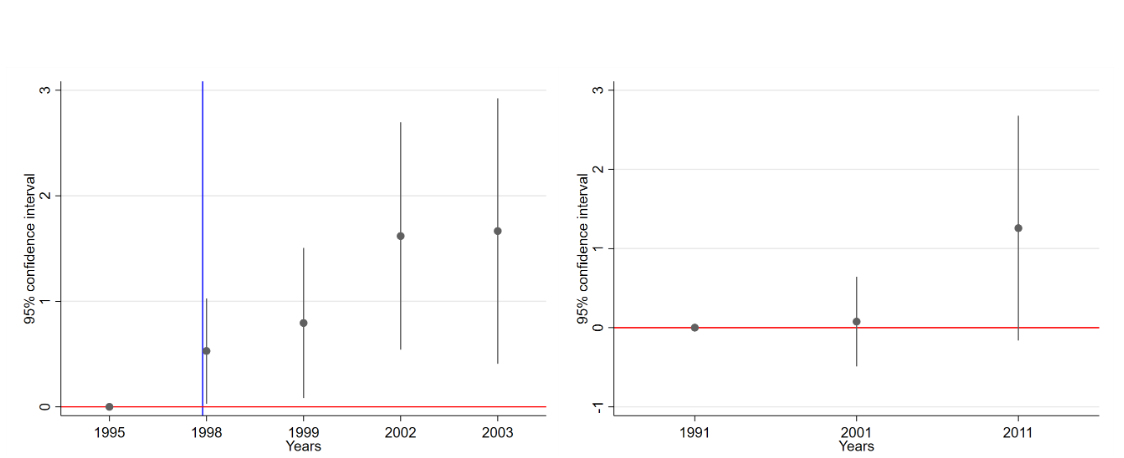
In Figure 1, the left panel shows that districts with pre-existing software exports experienced faster growth in IT employment after the boom, while the right panel shows that engineering enrolment also rose in these districts, but with a lag, in response to higher returns to technical education.
This lag is important for understanding adjustment dynamics. An engineering degree takes time to complete, so the labour supply response could not occur immediately. A high-skill trade shock affects the economy in two stages: it first raises demand for skilled workers, and then changes incentives to acquire skills. This complements evidence that globalisation and US technology demand raised returns to IT-relevant skills in India (Shastry 2012, Khanna and Morales 2024), and contrasts with evidence suggesting that Mexican export booms reduced schooling by raising its opportunity cost (Atkin 2016).
The employment gains were also much larger in districts that already had more engineering students before the boom. Regions with better access to higher education were therefore better positioned to convert export opportunities into local production. This pattern suggests that migration frictions matter. If workers could easily move to acquire education or take jobs, pre-existing local education capacity would matter less for where employment expanded. Instead, the gains from a high-skill export boom accrued disproportionately to places that already had the educational capacity needed to respond.
Moving for education is especially limited
Using confidential district-to-district migration data from the Indian Census, I separately estimate migration costs for work and education (Ghose 2026). Migration falls sharply with distance for both. State borders also matter: moving between neighbouring districts across state borders involves substantially higher costs than moving between neighbouring districts within the same state. This echoes Kone et al. (2018), who describe India’s state borders as “invisible walls”, showing that state borders restrict internal mobility.
But people are much less likely to move for education than for work. Among migrants, 47.5% moved for work, but only 2.9% for education. State borders are especially relevant for education because many higher-education institutions reserve seats for in-state students. Such reservation policies can raise the cost of acquiring education outside one’s home state.
This distinction is crucial. Lowering work-related migration costs only helps workers who already possess the relevant skills. In IT, workers without technical or college education cannot access engineering jobs even if those jobs are nearby. Barriers to acquiring education can therefore be more binding than barriers to moving for employment.
Why education access changes the gains from trade
To quantify these mechanisms, I develop a spatial equilibrium model in which individuals first decide whether and where to study, and whether to study engineering. Later, after education choices are made, they decide where and in which sector to work. The structure builds on spatial models with costly internal migration, including Bryan and Morten (2019), but adds an education decision before workers enter the labour market.
The model estimates that India’s IT boom increased welfare by the equivalent of a 2.39% rise in real income. More than half of the estimated welfare gains operate through education responses. Without the ability to move across districts to pursue higher education, aggregate gains would have been 25% lower and regional inequality about 1.5 times larger. Removing endogenous education altogether reduces the gains by more than one-third. The magnitude of these effects, despite high estimated migration costs for education, highlights the central role of skill acquisition in shaping who benefits from high-skill demand shocks.
Education policy can make globalisation more inclusive
The policy implication is that education policy may matter as much as labour-market policy in determining who gains from globalisation. Trade adjustment usually focuses on workers moving to jobs. But for high-skill sectors, people must first be able to move towards education. Policies that reduce barriers to higher-education mobility – such as national scholarships or reductions in in-state college quotas – can help poorer and remote regions benefit more from high-skill trade shocks, expanding access to skill acquisition beyond existing hubs.
These mechanisms are especially relevant today because India is experiencing another high-skill technology shock around artificial intelligence, cloud computing, and data-intensive services. Recent discussions on AI and India’s service-led growth model point to related policy concerns: human capital, university quality, and broad digital access are central to whether the country can sustain the model (Rajan et al. 2026). My framework suggests that these constraints may also shape which regions are able to participate in the next technology boom. The broader lesson is that globalisation disproportionately rewards regions where people can access the skills needed to compete. In a world where export opportunities increasingly depend on human capital, education access is not just social policy – it is central to how countries translate trade opportunities into broad-based gains.
References
Atkin, D (2016), “Endogenous skill acquisition and export manufacturing in Mexico”, American Economic Review 106(8): 2046–2085.
Bryan, G and M Morten (2019), “The aggregate productivity effects of internal migration”, Journal of Political Economy 127(5): 2229–2268.
Ghose, D (2026), “Trade, Internal Migration, and Human Capital: Who Gains from India’s IT Boom?”, working paper.
Goldberg, P K and M Ruta (2025), “The Changing Nature of International Trade and Its Implications for Development”, NBER Working Paper No. 34283.
Khanna, G and N Morales (2024), “The IT Boom and Other Unintended Consequences of Chasing the American Dream”, working paper.
Kone, Z. L., Liu, M. Y., Mattoo, A., Ozden, C., & Sharma, S. (2018). Internal borders and migration in India. Journal of Economic Geography, 18(4), 729-759.
Rajan, R, O Hanney and D Mousa (2026), “AI, India, and the future of service-led growth”, VoxDevTalk, 10 March.
Shastry, G K (2012), “Human capital response to globalization: Education and information technology in India”, Journal of Human Resources 47(2): 287–330.