








A land formalisation programme in Benin significantly increased the likelihood that widows – especially those without a son – remained in their villages, offering formal institutional protection where customary norms left women most vulnerable.
Editor’s note: The authors have made slide available here.
In most of the villages we visited in rural Benin in 2021, women described the aftermath of widowhood in similar terms, which often featured accusations of witchcraft, dispossession, forced remarriage, and poverty. In nearly every community, participants reported that widows routinely become poorer after their husband's death – sometimes through the loss of land and home, and sometimes through forced remarriage to a brother-in-law as the price of staying. A woman who resists may be forced to relocate as in-laws reclaim family land. In 2004, Benin formally prohibited these practices by passing a Family Code that granted surviving spouses inheritance rights and banned levirate. Only a few women in our focus group discussions reported being aware of the law.
We encountered this world not because we sought it out, but because our data made it impossible to ignore. We had been studying land formalisation and agricultural investment in Benin since 2011, but when we returned in 2015 to measure the programme's effects on investment and land markets, the data revealed something we had not anticipated: widow-headed households in control villages had left at a higher rate than those in treated villages.
This raised a methodological concern. The disproportionate disappearance of widow-headed households from control villages changes the composition of those villages and, to the extent that the households that remained have distinctive characteristics, the imbalance can confound long-run estimates of the effect of formalisation on land use. Before studying investment or land markets, we first had to understand why widows were more likely to remain in treated villages.
To make sense of what we observed, we consulted the evidence base on widowhood in sub-Saharan Africa. In many customary patrilocal systems, women access land through marriage rather than direct ownership. When a husband dies, those rights can become fragile, especially for widows without a son in the household who can help defend inheritance claims and deter dispossession by in-laws (Lambert and Rossi 2016, Lambert et al. 2018).
Could a land formalisation programme change this? Existing theory suggested that formal legal institutions can sometimes shift customary norms towards more equitable outcomes rather than simply replacing them (Aldashev et al. 2012), but empirical evidence remained limited.
Land formalisation in Benin
The Rural Landholding Plans (Plans Fonciers Ruraux, or PFR) were implemented in Benin between 2008 and 2011, with funding from the Millennium Challenge Corporation. The programme demarcated plots, mapped land rights, established elected village-level land management committees, and was designed to issue land certificates. Three hundred villages were randomly selected by public lottery from 576 eligible villages that volunteered to receive systematic land registration.
Several design features explicitly promoted gender equity. Volunteering villages were required to demonstrate support for women's and girls' right to inherit land. While land registration activities record primary land-right holders, additional efforts focused on formalising secondary land rights through formal contracts. The PFR also required women's representation in newly created land management committees.
We surveyed 3,507 households across treated and control villages in 2011 (Goldstein et al. 2018) and returned in 2015. To understand the community-level mechanisms driving what we observed, we also conducted a follow-up round of focus group discussions in 2021, with separate sessions for men and women across 71 villages. To study how land-rights formalisation affects widows, we focus on two groups: the 310 households already headed by widows in 2011, and the 2,912 households with married women in 2011, some of whom became widows between the two survey waves (Botea, Goldstein, Houngbedji, Kondylis, O’Sullivan, and Selod 2026).
Protecting women who were already widowed
Among widow-headed households in our 2011 sample, those in PFR villages were 11 percentage points more likely to still be living in their village four years later, a 14% increase over the control mean of 80.5%. Figure 1 shows where this effect is concentrated.
Figure 1: Widows without a son were much more likely to remain in their village following land registration
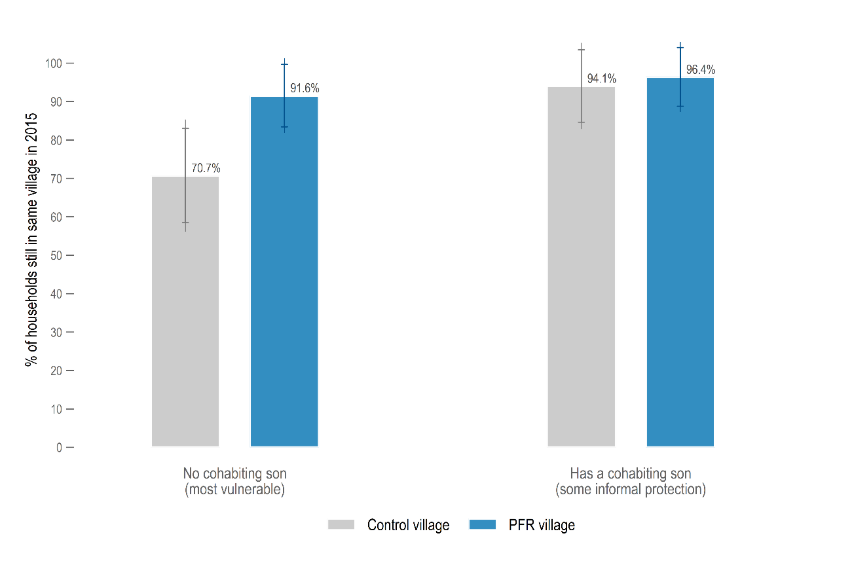
Notes: The figure reports the predicted probabilities that households already headed by widows in 2011 remained in their village by 2015. Capped vertical bars indicate 90% confidence intervals, while uncapped bars indicate 95% confidence intervals. Source: Authors' calculations.
In control villages, this pattern is exactly what the widowhood evidence base predicts: widows living with a son are 23 percentage points more likely to remain in their village than those without one. Sons provide powerful informal protection. In treated villages, the programme changed this picture. The treatment effect is concentrated among widows without a son in the household – the most vulnerable group under customary norms. For them, formalisation increased the likelihood of staying by around 21 percentage points: a magnitude comparable to what a son would have provided in a control village. For widows who already had a son's protection, the programme added nothing statistically significant.
For widows without a son, formal institutions provided the protection that male kin would otherwise have provided, filling the gap that a missing son would normally leave.
Protecting women not yet widowed
While the first finding may partly be attributable to efforts to protect widows' land rights during land registration, our second finding is more striking. Among the 2,912 households headed by married couples in 2011, women in PFR villages who lost their husbands between the two survey waves were 19% more likely to remain in their village than those who experienced widowhood in control villages.
Figure 2: Women who became widowed were more likely to remain in their village when the programme had previously been introduced
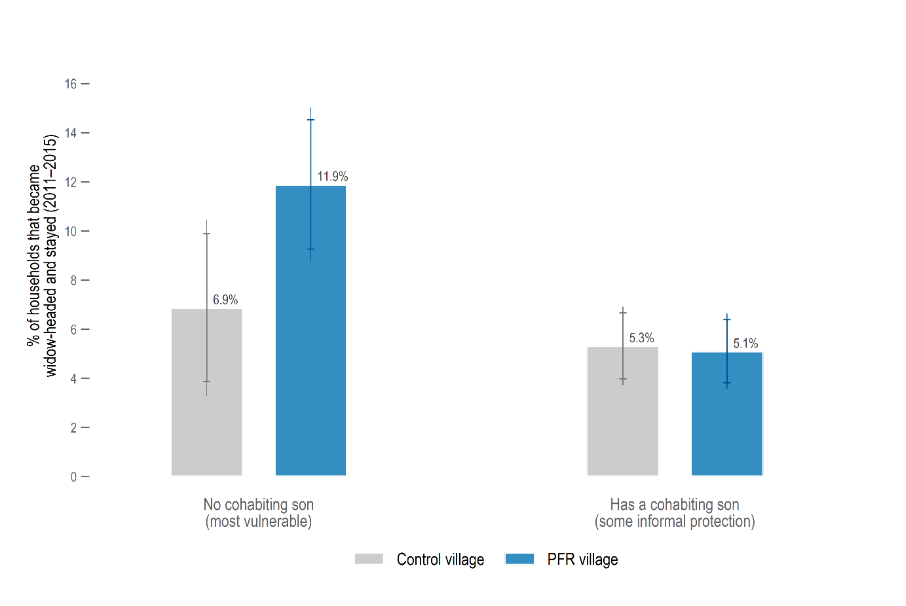
Notes: The figure reports the probabilities that households headed by married couples in 2011 experienced widowhood and remained in their village by 2015. Capped vertical bars indicate 90% confidence intervals, while uncapped bars indicate 95% confidence intervals. Source: Authors' calculations.
These women were still married when the programme ran and had not yet faced the pressures that follow a husband's death. Yet the institutional and normative changes the programme set in motion were sufficient to protect them when the moment came. Again, the effect is concentrated among those without a son in the household, for whom formalisation nearly doubled the likelihood that women who became widowed remained in their village.
The programme changed something durable about the environment in which widowhood is negotiated, before those women had any reason to expect they would need that protection. Consistent with this, widows in treated villages were less likely to remarry or enter levirate marriages. This suggests that formal tenure security gave women alternatives to the constrained options – such as levirate marriage – available in control villages.
How did formalisation protect widows?
By 2015, a nationwide land reform had halted the issuance of land certificates in PFR villages (Lavigne Delville 2023), and only 19% of the expected certificates had been issued. For this reason, the mechanism is unlikely to be the piece of paper itself.
Two channels appear to be at work. The first is institutional: the PFR promoted the registration of primary and secondary land-use rights through tenancy contracts and established elected land-management committees. In treated villages, these committees were more likely than councils of elders to address land-administration issues. Moreover, the probability that the primary land institution included at least one female member rose by 44.5 percentage points. Likewise, the likelihood of a woman holding a leadership position within a land-management institution increased by 7.4 percentage points, from virtually zero.
The second channel is perceptual. Married women in treated villages were significantly less likely to expect they would inherit nothing if their husband died, a 5-percentage-point reduction from a control mean of 58%. Men were also more likely to report that the programme improved tenure security specifically for women, with no equivalent effect for tenants or migrants. Our 2021 focus groups confirmed that awareness of Benin's Family Code was higher among men in treated villages.
Formalisation appears to have strengthened women's claims not only through formal legal institutions, but also socially. It shifted the informal bargaining environment in which widows negotiate their rights.
Two caveats deserve emphasis, however. The villages in our study had voluntarily committed to supporting women's land rights as a condition of programme eligibility and are therefore not representative of all Beninese villages. And we find no evidence that gains extended to broader empowerment outcomes such as agricultural revenues or personal autonomy. Retaining one’s home is not the same as controlling one’s economic life, but it is often a prerequisite.
We came to this question through a detour. As land registration programmes scale up across sub-Saharan Africa, and millions of widows face the same vulnerability we documented in those focus groups, we are glad the detour led us here.
References
Aldashev, G, I Chaara, J-P Platteau, and Z Wahhaj (2012), "Using the law to change the custom," Journal of Development Economics, 97(2): 182–200.
Botea, I, et al. (2026), "Right to stay? Long-run experimental evidence on land formalization and widows' tenure security in Benin," Journal of Development Economics, 179: 103675.
Goldstein, M, et al. (2018), "Formalization without certification? Experimental evidence on property rights and investment," Journal of Development Economics, 132: 57–74.
Lambert, S, and P Rossi (2016), "Sons as widowhood insurance: Evidence from Senegal," Journal of Development Economics, 120: 113–127.
Lambert, S, D van de Walle, and P Villar (2018), "Marital trajectories, women's autonomy and women's wellbeing in Senegal," in S Anderson, L Beaman, and J Platteau (eds), Towards Gender Equity in Development, Oxford Academic: 17–52.
Lavigne Delville, P (2023), "The political economy of land reform," in F Bourguignon, R Houssa, J Platteau, and P Reding (eds), State Capture and Rent-Seeking in Benin: The Institutional Diagnostic Project, Cambridge University Press: 247–297.