


In Afghanistan, counterinsurgency efforts weakened community ties and local trust – ultimately undermining the foundations needed for reconstruction and peace.
The 2021 Taliban takeover of Afghanistan ended two decades of foreign military engagement and triggered a wave of self-reflection among policymakers and military analysts. Reports by NATO and the Special Inspector General for Afghanistan Reconstruction (SIGAR) highlight the ignorance of prevailing political, social, and cultural contexts as one major reason why the foreign intervention failed. How does foreign military presence shape cohesion within the very communities it aims to stabilise? This question extends well beyond Afghanistan. Foreign security missions remain a cornerstone of international conflict management, from counterinsurgency operations in Iraq to peacekeeping in South Sudan. Yet most research on their effects focuses on violence outcomes or attitudes towards warring parties. Less attention has been paid to social ties within communities when foreign troops are present.
Why community cohesion is central to resolving conflict
In conflict-affected countries, the state often cannot provide basic services, protection, or dispute resolution. These functions fall to local community structures – in Afghanistan, the shura or jirga, traditional village councils deeply rooted in local culture. Communities rely on these informal institutions for governance, resolving disputes, and supporting households in times of need. Research has long shown that social cohesion – the trust, mutual assistance, and collective action within communities – matters for development (Knack and Keefer 1997). Local development projects are less likely to succeed in fractured communities. Counterinsurgency efforts similarly become more difficult when troops cannot rely on community cooperation.
New evidence from Afghanistan
In recent work (Langlotz 2026), I focus on Afghanistan between 2005 and 2010 to examine the effect of the International Security Assistance Force (ISAF) – one of the largest military coalitions in NATO's history – on community cohesion. ISAF's stated mission was to provide security for reconstruction and humanitarian efforts. I draw on three large household surveys to capture social cohesion across multiple dimensions: mutual assistance, engagement with local councils, and trust in neighbours and local institutions. To isolate the effects of the presence of foreign troops from broader conflict dynamics, I use two complementary empirical strategies. The first exploits the stepwise geographic expansion of ISAF's mandate between 2003 and 2006. When UNSC Resolution 1510 extended the mission from in and around Kabul to northern Afghanistan, it created a geographic boundary between treated and control communities. Comparing households on either side – a geographic regression discontinuity design – approximates random assignment. Figure 1 illustrates six geographic segments that allow comparison of households that were close to one another but exposed differently to ISAF's mandate and troop presence.
Figure 1: Boundary of ISAF's mandate enlargement to the North
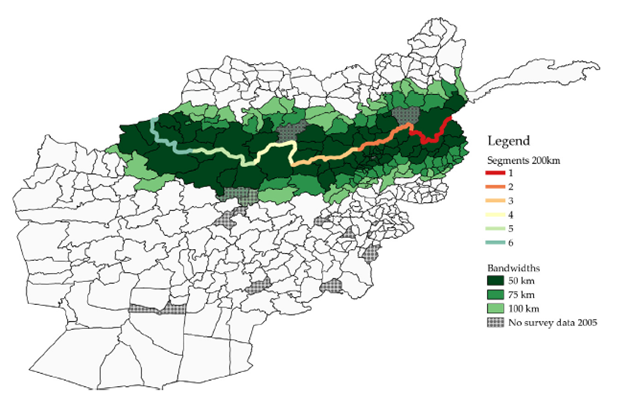
Note: The boundary splits the country into the northern command (treated), where ISAF's mandate was extended to in December 2003 (completed end of 2004), and the rest of the country (control), where ISAF has been deployed to after the 2005 National Risk and Vulnerability Assessment has been conducted. Highlighted are the six boundary segments à 200 km, three different bandwidths, and the districts for which no survey data is available in the 2005 wave.
The second strategy tracks how outcomes evolved across the entire country during ISAF's operational intensification from 2005 to 2010, using quasi-panel methods that control for time- and district-specific factors as well as prior conflict levels. ISAF presence in this second phase is measured using military base locations, building on Gehring et al. (2025), and the number of counterinsurgency projects carried out by ISAF's civilian-military Provincial Reconstruction Teams (PRTs). The latter draws on data from Child (2019).
Foreign troops erode the social fabric
Across methods, surveys, and outcome measures, ISAF presence is associated with weaker community ties across multiple dimensions. Figure 2 summarises the short-term effects of the mandate expansion. In areas that the ISAF mandate was extended to, households were significantly less likely to receive help from others across multiple measures of assistance, and less likely to have a family member participating in a local council. This reduced membership is driven by Community Development Councils (CDCs), governance bodies introduced under the National Solidarity Program and strongly associated with the government and international partners. The effect on traditional shura membership is smaller and less precisely estimated, possibly reflecting the shura's greater legitimacy relative to the externally introduced structures.
Figure 2: Cohesion in and outside of ISAF's mandate, 2005
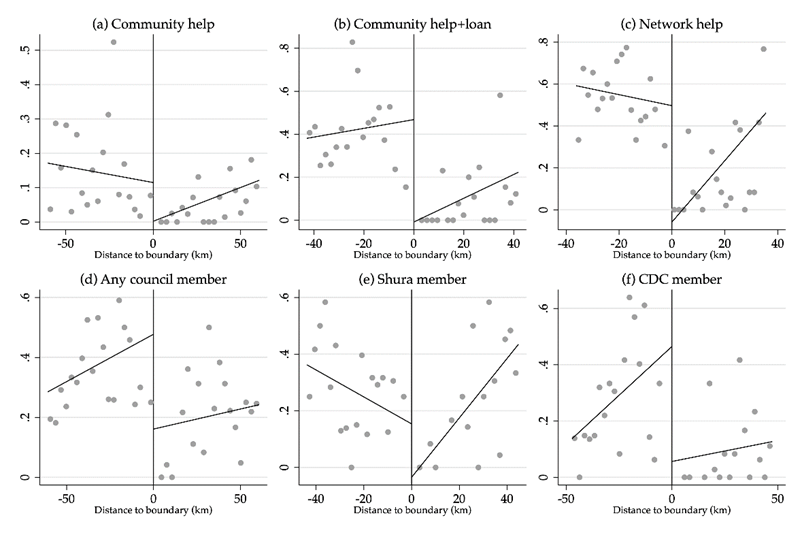
Note: Based on data from the 2005 National Risk and Vulnerability Assessment. Each dot represents a binned average; the vertical line marks the boundary as shown in Figure 1. Measures of community cohesion are lower in the treated areas (right to the zero line). The estimation is based on local first-order polynomials with data-driven bandwidths.
Over the period of country-wide operational intensification, the picture regarding mutual assistance within communities is more mixed. Effects are smaller and not always precisely estimated, suggesting that the impact on social support is most pronounced following the initial geographic expansion. Yet, Figure 3 shows that engagement with local community councils continues to point downward in the 2006–2010 period, measured by reliance on the shura for dispute resolution. Evidence also points to reduced trust in both shuras and other people, particularly in areas near large military bases.
Figure 3: Effects of a large ISAF base being present in the district, 2006–2010
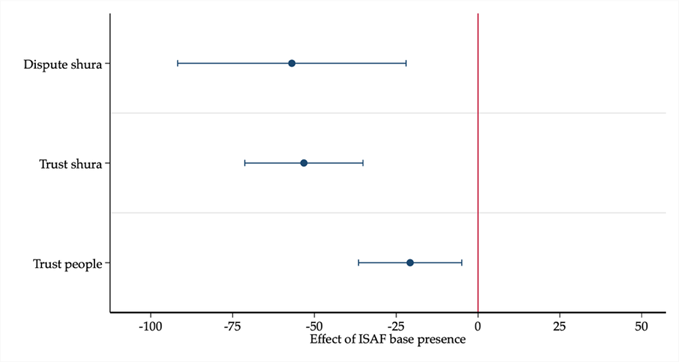
Note: Based on data from the Survey of the Afghan People. Results presented as % change relative to each outcome's average; 95% confidence intervals shown.
What is driving this erosion?
My findings do not support an explanation based on improved formal institutions crowding out informal support: there is no consistent evidence that the presence of foreign troops improved living standards, household employment, or access to services in ways that would reduce dependence on community networks.
When troops in the same uniform were seen both fighting insurgents and building clinics, communities could not easily distinguish military from development actors. My results indicate that where military bases were present, World Bank aid had smaller – and partly even negative – effects on household living standards compared to areas without foreign troops. These dynamics echo findings from other studies emphasising the need for caution when involving foreign militaries in the delivery of aid services (Child 2019).
Turning to counterinsurgency dynamics, the 2005–2010 period was defined by fighting between the Taliban on one side and pro-government forces, including ISAF, on the other. Areas exposed to military bases experienced higher levels of violence over time, including increased civilian deaths. Some evidence also points to greater fear when travelling, particularly in areas near large military bases. Survey evidence further indicates that households in ISAF-exposed areas were more likely to perceive ISAF as a source of insecurity. Confidence in local institutions – both traditional shuras and the government-linked CDCs – declined alongside the presence of large military bases and rising insecurity. These patterns align with accounts from the period: ISAF was repeatedly criticised for bypassing existing local councils, creating confusion about authority. As ISAF commander General David Richards noted at the time, "if you are an Afghan who has spent 30 years fighting, you have learned not to put faith in the wrong side, because it comes back to haunt you" (RUSI 2007).
What this means for foreign policy
These findings carry important implications for how we design and evaluate foreign security missions. First, the erosion of community cohesion appears to be a structural consequence of introducing a powerful external actor into communities with fragile trust and competing loyalties – not a side effect manageable with better communication strategies.
Second, community cohesion and the interaction between military presence and aid should be core metrics in designing and evaluating security missions. If the social fabric is eroded by the intervention meant to protect it, this undermines counterinsurgency and long-term nation-building.
Third, these findings should not be read as a general indictment of all forms of international military engagement. ISAF's PRT projects – combining civilian and military functions – show weaker and less consistent negative effects than bases, particularly on trust, consistent with their smaller footprint of violence. During the 2005-2010 period, ISAF was primarily a counterinsurgency operation – fundamentally different from UN peacekeeping missions, which very rarely use force. Research shows that peacekeeping troops can be effective at protecting civilians and reducing violence when adequately deployed (Hultman and Mousa 2025).
References
Child, T B (2019), “Conflict and counterinsurgency aid: drawing sectoral distinctions,” Journal of Development Economics, 141: 102245.
Gehring, K, S Langlotz, and S Kienberger (2025), “Stimulant or depressant? Resource-related income shocks and conflict,” Review of Economics and Statistics, 107(6): 1518–1536.
Hultman, L, and S Mousa (2025), “From ceasefire to cohesion: an integrated review of peacemaking and peacebuilding,” Economic Policy, 40(124): 931–967.
Knack, S, and P Keefer (1997), “Does social capital have an economic payoff? A cross-country investigation,” Quarterly Journal of Economics, 112(4): 1251–1288.
Langlotz, S (2026), “Foreign interventions and community cohesion in times of conflict,” Journal of Development Economics, 182: 103751.
RUSI (2007), “RUSI interview with General David Richards,” RUSI Journal, 152(2).