





Two low-cost interventions targeting adolescent girls and boys separately each produced large, cost-effective reductions in intimate partner violence in Tanzania.
Editor’s note: Please email Manisha Shah for slides
The World Health Organization estimates that 26% of women worldwide have experienced intimate partner violence (IPV), defined as behaviour by an intimate partner or ex-partner that causes physical, sexual, and/or psychological harm. Most interventions to tackle IPV focus on adults, usually women and/or couples, while interventions targeting men are less common, especially in low- and middle-income countries. For example, in a recent systematic review of programmes to prevent IPV, none focused exclusively on adolescents or included young adolescents under the age of 15, and only five of 26 studies included young people under the age of 18 (Alsina 2024). Only three studies focused on men (Alsina 2024). Likewise, in the economics literature, most theories of IPV focus on married couples (Shah and Barski 2026). However, IPV often begins in adolescent relationships, and early exposure is a strong predictor of victimisation later in life.
Underlying the behaviours that lead to IPV are social norms and a lack of bargaining power or broader agency of female partners. These norms coalesce during adolescence, contributing to high rates of IPV among adolescent girls. In Tanzania, our country of study, 32% of ever partnered 15–24-year-old women and girls report experiencing IPV (Wado et al. 2021).
Shifting gender dynamics through targeted adolescent interventions
To understand how these dynamics might shift, we implemented two distinct interventions: one for adolescent girls and young women, and one for adolescent boys and young men (Shah, Seager, Montalvao, and Goldstein forthcoming). Female participants were sampled from BRAC’s adolescent empowerment clubs. Facilitators worked with participants to set goals about sexual and reproductive health, focusing on SMART goals (specific, measurable, achievable, relevant and time bound) – which would help the adolescent girls and young women build clear strategies to reach their goal (Doran 1981).
Adolescent boys and young men participated in Grassroot Soccer, a programme that conveys messages about risky sexual behaviour, HIV, and IPV in the context of soccer practices. For example, in a ‘Red Card’ session, trainers work with participants to talk about red-card-worthy behaviour in the context of relationships, covering topics such as pressuring women to have sex and gender-based violence. This intervention was targeted at males in the same social and sexual networks as females in our sample. We set our experiment up so that we could look at the impact of soccer and goal setting together, but also separately.
Figure 1: The Grassroot Soccer programme
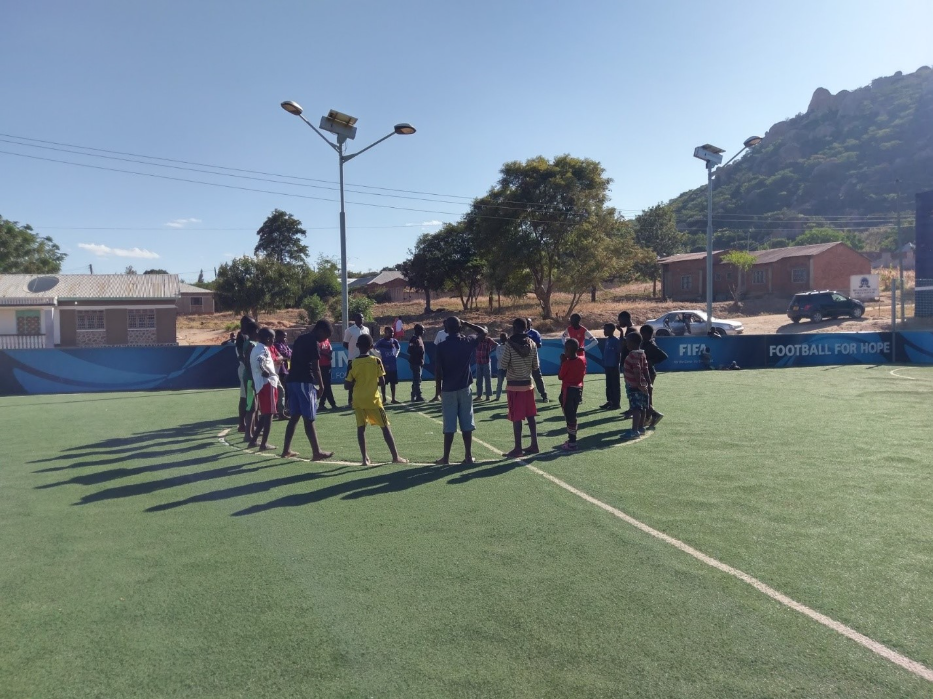
Photo credits: Jennifer Seager.
Both gender-specific interventions reduced intimate partner violence
Both interventions led to decreases in intimate partner violence. The soccer intervention led to a drop of 5.1 percentage points, or 60%, in reported intimate partner violence among females who were partnered and sexually active when our study started. The goal setting intervention led to an 8.7 percentage point drop (or 100%) among the females partnered and sexually active at baseline and 2.3 percentage points (or 58%) in the whole sample. Given the large magnitude of these effects within this setting, combining the two interventions yields no significant additional reductions in IPV.
While the reductions in IPV from the two interventions were similar in magnitude, the mechanisms are different. In the soccer intervention, we see a significant improvement in males’ perception of risky behaviour (e.g. they are more aware of HIV and STI risks). This is coupled with a statistically significant reduction in sexual activity and, for those enrolled in the programme, improved attitudes about violence against women.
The goal setting intervention resulted in a range of strategies for women and girls, with abstinence and condom use being the two most common. At endline, we find that females who set these strategies were more likely to report doing them. Part of achieving these goals likely involved switching partners: women and girls are 3.9 percentage points less likely to be with the partners they had at baseline. This is driven by females experiencing IPV at baseline, who are 30.5 percentage points less likely to remain with their initial partners.
One concern may be that IPV experiences and sexual behaviours are self-reported and are therefore subject to recall error and/or social desirability bias. Participants exposed to the interventions may have become more aware of socially acceptable responses, potentially affecting reporting patterns. However, the consistency of the findings across multiple related outcomes provides some reassurance that the observed effects reflect meaningful behavioural changes. Additionally, all females were exposed to similar messaging around IPV and relationships, as all were members of BRAC’s empowerment clubs.
Cost-effective approaches to reducing violence against women
These were relatively inexpensive interventions. The soccer intervention cost around US$41 per participant, while the goal setting intervention cost US$38 per participant. Focusing on the cost per violence averted (in our case measured by adolescent girls and young women reporting they experience IPV often), this compares favourably with other violence interventions and is slightly more expensive than the cost of adolescent girls’ clubs implemented by BRAC in Uganda (Bandiera et al. 2020).
Taken together, these two interventions demonstrate effective paths to shifting the power balance around intimate partner violence among adolescents. The goal setting intervention helped women and girls take more control of their sexual life, leading them to choose less violent partners. The soccer intervention shifted males’ perceptions – both on violence directly and the risky sexual behaviours that correlate with violence, resulting in them having less sex.
These results suggest that including males in programming can be an effective component of broader strategies to reduce adolescent IPV. In fact, policymakers may benefit from integrating goal-setting and gender-norms programming with young men into existing initiatives as they are relatively inexpensive to implement. Future research should examine the long-term persistence of these effects and assess whether similar interventions can be successfully adapted and scaled in other contexts.
References
Alsina, E, J L Browne, D Gielkens, M A J Noorman, and J B F de Wit (2024), "Interventions to prevent intimate partner violence: A systematic review and meta-analysis," Violence Against Women, 30(3–4): 953–980.
Bandiera, O, R Burgess, M Goldstein, S Gulesci, I Rasul, and M Sulaiman (2020), "Women's empowerment in action: Evidence from a randomized control trial in Africa," American Economic Journal: Applied Economics, 12(1): 210–259.
Shah, M, and L Barski (2026), "Intimate partner violence in low- and middle-income countries: Insights from economic research," Journal of Economic Literature, 64(2): 403–446.
Shah, M, J Seager, J Montalvao, and M Goldstein (forthcoming), "Sex, power, and adolescence: Intimate partner violence and sexual behaviors," Review of Economics and Statistics.
Doran, G T (1981), "There's a S.M.A.R.T. way to write management's goals and objectives," Management Review, 70(11): 35–36.
Wado, Y D, M Mutua, A Mohiddin, M Ijadunola, C Faye, C Coll, A Barros, and C Kabiru (2021), "Intimate partner violence against adolescents and young women in Sub-Saharan Africa: Who is most vulnerable?" Reproductive Health, 18(Suppl 1): 119.