





Ethiopia’s industrial parks have substantially increased local economic activity, household living standards, and women’s empowerment, but the gains stay close to the parks and depend heavily on where parks are built.
Editor’s note: For a broader synthesis of themes covered in this article, check out our VoxDevLit on Industrial Development.
Industrialisation remains one of the most reliable routes out of poverty (Rodrik 2014). Yet building a competitive manufacturing sector requires reliable infrastructure, dependable utilities, and supportive institutions, all of which many low-income countries struggle to provide nationwide. Faced with this constraint, a growing number of governments have turned to industrial parks: geographically delimited zones equipped with serviced land, power, regulatory incentives, and streamlined administration, designed to create localised pockets of competitiveness that attract firms, especially foreign investors (Farole 2011, UNIDO 2023).
Policy-wise, this is ambitious. Parks are expected to create jobs, lift exports, transfer technology, and ultimately catalyse broader structural transformation. Although rigorous evidence on industrial policy has grown rapidly in recent years (Juhász et al. 2024, Amodio et al. 2026), it remains scarce for low-income settings, despite the proliferation of parks across Africa over the past two decades. Most credible studies focus on advanced and emerging economies such as the US, China, and India. In recent work (Huang, Wang, and Xu 2026), we help fill this gap by providing a comprehensive evaluation of industrial parks in Ethiopia.
Evaluating the impact of Ethiopia’s industrial parks
Over the last two decades, Ethiopia has made industrial parks a centrepiece of its development strategy. To evaluate this policy, we collect data from the Industrial Parks Development Corporation and the Ethiopian Investment Commission, recording each park’s location, opening year, ownership, size, and sectoral specialisation. Of the 22 operational parks in our sample, the first opened in 2008 and the rest followed in a staggered sequence through 2021 (Figure 1). Reflecting concerns about political balance and regional equity, the parks are dispersed across the country: some sit near major urban centres, while others are placed in more remote southern and western regions.
The parks have an average developed area of roughly 220 hectares. Sixteen are publicly owned and operated, and the remaining six are private. More than half specialise in labour-intensive sectors – textiles, apparel, and leather – while several others focus on more advanced industries such as ICT and pharmaceuticals. The staggered rollout, with parks arriving in different districts at different times, provides the variation underlying our empirical strategy. We exploit it in a difference-in-differences framework, comparing districts that received a park with comparable districts that did not, before and after park operations began.
Figure 1: Geographic distribution of industrial parks in Ethiopia
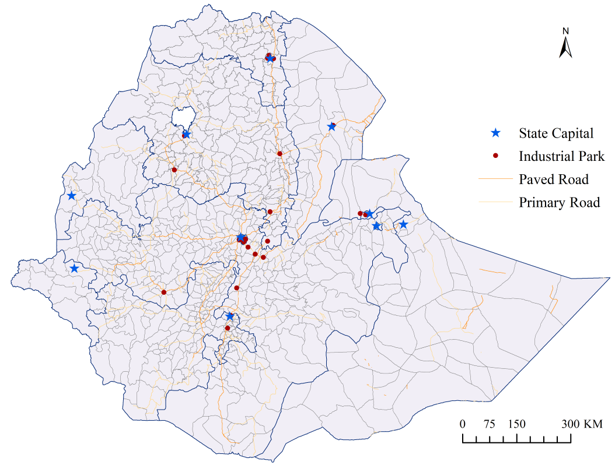
Notes: This map illustrates the locations of industrial parks and state capitals within Ethiopia, along with the layout of paved and primary roads. Industrial parks are marked by red dots, while state (regional) capitals are denoted by blue stars. Sources: Industrial Parks Development Corporation and Ethiopian Investment Commission.
Industrial parks light up the map: Local economic activity and urbanisation
Industrial parks substantially increase local economic activity. Following the opening of a park, nighttime light intensity in host districts rises by about 26.5%, and the impervious surface ratio, which captures the share of land sealed by buildings, roads, and other structures, increases by roughly 3 percentage points. Given Ethiopia’s low starting point, these are economically meaningful gains.
Crucially, host and comparison districts were on the same path before any park opened. The gains appear only once a park starts operating and then build steadily as firms move in and ramp up production (Figure 2). This is exactly the pattern we would expect if the parks themselves, not some pre-existing trend, are driving the gains.
Figure 2: Effect of industrial parks on nighttime light intensity and impervious surface ratio
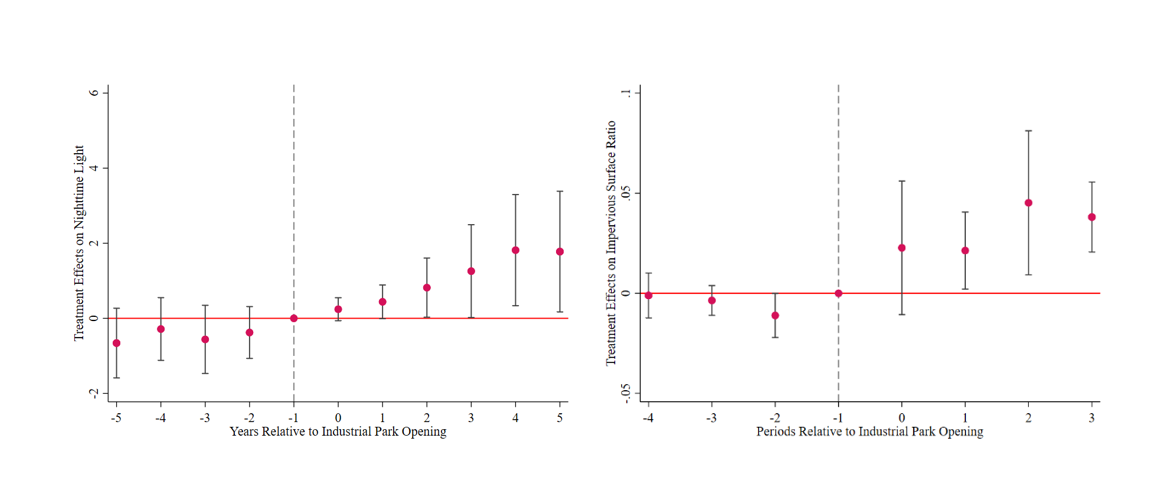
Notes: The markers at the left and right ends of the timeline represent average effects observed five years before and five years after the opening of industrial parks for nighttime lights (four periods before and three periods after for the impervious surface ratio), respectively. All effects are normalised relative to the period immediately preceding park opening.
Industrial parks lead to local gains, not regional ones
A natural worry is whether these gains are genuinely new or simply pulled in from neighbouring areas. The flip side matters too: do parks lift their neighbours as well, as firms buy from local suppliers and pass on know-how? We find little evidence of either. Districts located close to an operational park show no measurable change in economic activity relative to those farther away.
The absence of spillovers likely reflects Ethiopia’s shallow domestic supplier base and weak linkages between parks and local producers: firms in parks rely heavily on imported inputs, so the economic benefits remain concentrated within host districts. At this stage of development, parks function more as self-contained production enclaves than as catalysts for broad regional upgrading. Reassuringly, this also means the local gains are not coming at the expense of neighbouring areas.
Ingredients for a successful industrial park: Location and sector
Parks do not all perform equally well; instead, their effect depends heavily on where they are built.
- Market access matters first. Parks located closer to major cities and regional capitals generate substantially larger gains in local economic activity. As a park’s distance to the nearest large city grows, the boost to nighttime lights and to the impervious surface ratio shrinks markedly.
- Transport connectivity matters too. Parks in districts with denser primary and paved road networks deliver significantly larger increases in economic activity and urbanisation, whereas parks in poorly connected districts have little measurable impact.
- Sectoral fit matters as well. Parks that host labour-intensive industries, such as textiles, apparel, and leather, outperform those in other sectors, because these activities align with Ethiopia’s comparative advantage in abundant, low-cost labour.
Together, these patterns reinforce a simple message: underlying location and sectoral fundamentals largely shape how much a park delivers, cautioning against politically motivated or spatially dispersed placement.
Industrial parks improve living standards
Do these district-level gains translate into better lives for local households? They do. After a park opens, households in host districts own significantly more durable goods: about 0.23 additional items per capita, a substantial increase given the low baseline. Housing quality improves markedly too: the probability that a household has access to electricity, piped water, a toilet, and a finished floor rises by about 25 percentage points. A composite wealth index rises by roughly 0.4 standard deviations. These improvements are plausible given that firms within parks hire locally and pay wages above those available in surrounding communities.
Industrial parks helped create jobs and empower women
Parks’ effects on employment are also strongly gendered. Because Ethiopia’s parks concentrate in labour-intensive sectors that traditionally employ women, the arrival of a park sharply raises female non-agricultural employment, while leaving male employment largely unchanged. In effect, industrial parks substantially expand off-farm work for women and narrow the pre-existing gender gap in non-agricultural employment within local labour markets.
These better economic opportunities translate into greater empowerment. Women in host districts are more likely to have a say in key household decisions and to have a savings account, while acceptance of domestic violence falls markedly. Taken together, these findings suggest that by drawing women into paid work, industrial parks can reshape gender norms and advance women’s economic and social standing, not just their incomes.
Policy implications for industrial development
Ethiopia’s experience offers several lessons for the many low-income countries betting on industrial parks. First, site selection is paramount: governments should prioritise locations with strong market access, adequate transport infrastructure, and large labour pools, as these fundamentals largely determine how much a park ultimately delivers. Second, because gains so far stay local, complementary policies that strengthen domestic supplier capabilities and reduce labour-market frictions are essential to convert localised enclave effects into broader regional development. Third, given the substantial fiscal cost of building parks, careful sectoral targeting, particularly towards activities aligned with a country’s comparative advantage, is crucial to ensure scarce public resources generate high returns.
References
Amodio, F, M Poschke, B Caprettini, J Choi, H Huang, Y-H Lei, T Reed, R Rodrigo, L F Sáenz, M Sanfilippo, M Schwartzman, G de Souza, M Sposi, and V Wiedemann (2026), "Industrial development," VoxDevLit, 22(1).
Farole, T (2011), Special Economic Zones in Africa: Comparing Performance and Learning from Global Experiences, World Bank Publications.
Huang, G, M Wang, and H Xu (2026), "The socioeconomic impacts of industrial parks in Ethiopia," Journal of Urban Economics, 154: 103867.
Juhász, R, N Lane, and D Rodrik (2024), "The new economics of industrial policy," Annual Review of Economics, 16(1): 213–242.
Rodrik, D (2014), "The past, present, and future of economic growth," Challenge, 57(3): 5–39.
UNIDO (2023), "Industrial parks overview," United Nations Industrial Development Organization.