





Policies that allocate scarce resources often embed hidden values. We develop a method to recover the value judgments implicit in allocation rules and apply it to Mexico’s flagship cash transfer programme, PROGRESA. The results demonstrate how future policies can be shaped to align with the values of policymakers and constituents.
Governments routinely decide who receives scarce resources: which households receive cash transfers, which patients receive treatment first, which firms receive subsidies, and which applicants receive limited public support. Each of these decisions reflects judgments about whose welfare matters, which outcomes matter, and how trade-offs should be made.
Yet the values embedded in these decisions are often hard to see. Consider a cash transfer programme that gives priority to poorer households. This could reflect a deliberate preference for the poor. Or it could be that the policymaker values all households equally, and poorer households simply benefit more from the transfer (i.e. they produce the biggest 'bang for the buck'). Conversely, a policy that appears neutral across groups could conceal strong preferences if some groups that are being equally prioritised actually benefit much less from the same intervention.
This distinction matters because many policy debates focus on the mechanics of allocation – eligibility cutoffs, scoring formulas, or the weights assigned to particular variables – while leaving the underlying values implicit. If a policy prioritises one household over another, is it because that household is expected to benefit more, or because the policy places greater weight on that household's welfare? Answering this question requires looking not only at who receives support, but also at how much different people benefit from it. This builds directly on prior research in public economics showing how tax schedules imply welfare weights (Hendren 2020, Saez and Stantcheva 2016), econometric advances in estimating heterogeneous treatment effects (Wager and Athey 2018), and recent empirical work showing that the people who most benefit from a cash transfer are not always the poorest (Haushofer et al. 2025). Our paper shows how these methods can be used to audit existing policies and better align future policies with values and preferences.
A new method
In our research (Björkegren, Blumenstock, and Knight 2025), we develop a method to invert this discussion. Rather than debating the end allocation, we recover the values it implies. The key to doing this is knowing how different people are affected by an intervention, or, in other words, how treatment effects are heterogeneous. Once we know how much each household benefits from an intervention, we can identify whether a policy tends to allocate treatment to households that benefit more, or to certain groups despite benefits being similar. This allows us to infer the values in existing policies, as well as the values implied by a new policy proposal. We can then compare these implied values to objectives.
What are the values implicit in PROGRESA?
We demonstrate our approach concretely with the example of PROGRESA, Mexico's landmark conditional cash transfer programme. Launched in 1997, PROGRESA provided transfers to poor households; its staggered rollout across 506 villages created one of the most studied randomised evaluations in development economics (Parker and Todd 2017). The programme has since served as a template for conditional cash transfers around the world. We consider the initial version of PROGRESA, which ranked households by a poverty score, which had a somewhat opaque construction. We recover the programme's implicit priorities using estimated treatment effects on consumption, child health, and school attendance. The method produces the value audit table shown below. A negative value on income means the policy places more weight on lower-income households; a positive value on household size means it favours larger households.
Our results reveal something interesting about how the policy valued indigenous households. PROGRESA ranked indigenous households about 60% higher in the poverty score. Taken at face value, this seems to suggest that the policy favoured indigenous households. However, indigenous households benefited much more from the programme, especially in terms of consumption. When that difference in impacts is taken into account, we find that the policy has no implicit favouritism towards indigenous households, and in fact there is some evidence that they were slightly disfavoured (as shown by the -0.17 in the value audit table). The fact that they are ranked more highly can be explained by the programme simply prioritising them higher because they gain more from the intervention. This means that critics who might accuse the policy of ethnic favouritism would not be seeing the full picture. Our method reveals why.
We also assess other possible types of favouritism. We find that the policy implicitly places more value on lower income households, larger households, and households with less educated household heads. Overall, the policy is not egalitarian. Our method also reports how the policy values outcomes, relative to households themselves. The key finding here is that the policy values outcomes differently from households (what economists would call paternalism). In particular, it values consumption more than households do themselves. That could result, for example, if programme designers are worried that parents aren't spending enough on children, and so target the transfers to the households that consume more of the transfer directly, rather than saving it.
Table 1: Value audit for PROGRESA (as of 1999)
| Value placed on households | |
| Indigenous | -0.17 |
| Income (log) | -0.19 |
| Household size | 0.11 |
| Household head age | -0.02 |
| Household head is educated | -0.74 |
| Value placed on outcomes by policy, relative to households | |
| Consumption (log, per capita) | 6.06 |
| Missed school days | -0.47 |
| Child sick days | -0.05 |
| Properties of decision rule | |
| Egalitarian? | No |
| Paternalistic? | Yes |
Do these values match those of constituents? We surveyed residents of Mexico in 2023 to assess. We find that by and large, residents of Mexico report values similar to those implemented in PROGRESA: they prefer cash transfers be given out in a non-egalitarian way and that the programme weigh consumption more heavily than households would themselves. However, Mexican residents actually favour indigenous households. The value audit allows us to identify this mismatch, which can then be corrected.
If you know the values that should be encoded in a policy, you can then go in the reverse direction and identify an alternative policy that aligns better. We show the full space of possible policies based on the outcomes they deliver in Figure 1. A point in the plot represents a policy that delivers the given average level of outcomes (across consumption, sick days, and missed school days). The curved surface represents the policies that deliver the frontier of best possible outcomes. When points are close together, this suggests that they deliver similar average outcomes. We find that the implemented policy (highlighted point: 'HH Pov Score') is actually quite close to the policy that follows the values of the Mexican residents we surveyed ('Survey'). However, one can also imagine more extreme policies that only value one outcome, such as education. One can also assess alternative proposed policies.
Figure 1: Expected programme impacts under alternative preferences
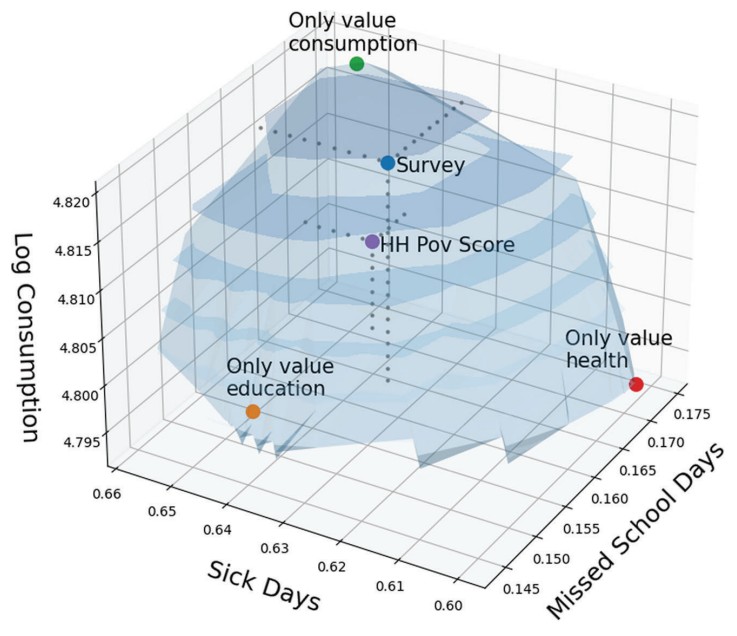
Notes: The frontier of possible average welfare impacts under alternative allocations. Different values lead to different points in outcome space. Source: Björkegren et al. (2025).
How can value audits be used?
These types of value audits can be used by two kinds of groups:
- Policymakers can use them to assess either existing policies, or prospective policies prior to implementation.
- Civil society groups can also use this tool to more deeply engage with the policies that affect them, even without the permission of policymakers. For example, a local NGO could run a value audit on a proposed vaccine allocation and bring the results to a public hearing, or publish it to spur discussion.
The method can be applied in settings where scarce resources are allocated and treatment effects can be estimated – from anti-poverty programmes to vaccine distribution, university admissions to small business grants. The varying treatment effects can be obtained if the programme is piloted using an RCT.
Towards policy better aligned with values
Policy discussions tend to revolve around the means, that is, the mechanics of implementation, rather than the ends: who we value and what outcomes we care about. Value audits like those produced by our method make it possible to flip these debates. We hope that this approach can lead to a virtuous cycle of policymaking, where stakeholders audit the values implied by proposed policies; and if they diverge from their values, redesign the allocation accordingly. This could lead to more productive policy discussions, and policies that better reflect our values.
References
Björkegren, D, J E Blumenstock, and S Knight (2025), “What do policies value?” Review of Economic Studies, rdaf089.
Haushofer, J, P Niehaus, C Paramo, E Miguel, and M Walker (2025), “Targeting impact versus deprivation,” American Economic Review, 115(6): 1936–1974.
Hendren, N (2020), “Measuring economic efficiency using inverse-optimum weights,” Journal of Public Economics, 187.
Parker, S W, and P E Todd (2017), “Conditional cash transfers: the case of Progresa/Oportunidades,” Journal of Economic Literature, 55(3): 866–915.
Saez, E, and S Stantcheva (2016), “Generalised social marginal welfare weights for optimal tax theory,” American Economic Review, 106(1): 24–45.