



New evidence from colonial India shows how economic ideas can influence civil servants and shape policy for decades, determining whether governments respond decisively to crisis or not at all.
Editor's note: The author has made slides available here.
The success of government policy critically depends on the civil servants charged with implementing it, but their implementation often falls short of policy objectives. Traditionally, economic theory has emphasised a perspective in which imperfect implementation arises from a principal-agent problem, where policy delivery is undermined by antisocial agent behaviour such as shirking or corruption.
In another view, however, these differences may arise from the imperfect information and expectations of political agents (Rodrik 2014), such as differences in their beliefs about the consequences of policy and which course of action would best achieve the goals of government. In this view, economic ideas could be particularly important, especially where they predict a causal relationship between a policy and its potential objective. If so, then adoption of these ideas might sway the decisions of civil servants as they consider how to direct public resources or their own efforts, changing how policy is implemented.
Various episodes suggest that economic ideas have had exactly this type of influence, and have even undermined policy objectives. For example, the widespread adoption of Keynesian ideas in the US by the 1960s and 1970s may have led policymakers to pursue ineffective policies concerning rates of unemployment and capital investment (Feldstein 1981). Similarly, the reversal of many twentieth century trade restrictions was facilitated by the development and diffusion of economic ideas favouring market-based exchange rates (Irwin 2025).
Challenges and progress with measuring the influence of ideas
However, it is difficult to truly measure the effects of ideas on policy. A fundamental issue with studying the influence of economic ideas involves distinguishing between an actual influence of the ideas themselves, versus an alternative explanation that officials merely invoke them to justify their actions. Recent work, however, has made progress in isolating the effects of ideas by studying their diffusion through economics training, and answers these questions in the affirmative. In one study, economics training delivered to federal judges in the US in the late twentieth century was found to lead to more conservative rulings and greater use of economic language in judgments (Ash et al. 2026). Despite this recent evidence, many modern strategies for recruiting, training, or promoting civil servants neglect to address the potential influence of ideas on officials more broadly.
One reason for this is that we don't understand the extent to which different types of ideas affect civil servants charged with implementing policy, and over what duration these effects might last. If ideas have only a small influence on the discretion of bureaucrats, or if their effects decay rapidly after training, then governments would be justified in neglecting to address these potential influences. However, if ideas play a substantial role in shaping their behaviour and decisions, then governments could better achieve their goals by addressing these forces directly.
A new approach: Malthusian ideas in colonial India
In my research (Robertson 2026), I answer these questions by focusing on a unique historical episode involving the 1805 appointment of Thomas Malthus to a college near London that trained civil servants. This episode led to one of history's most systematic diffusions of economic ideas directly from academia into the ranks of the civil service.
He taught each successive cohort of civil servants dispatched from the college to India over the next thirty years until his abrupt death in 1834, when he was replaced by the economist Richard Jones. Malthus is best known for his theory of population, in which he argued that excessive levels of population lowered incomes and led to natural checks on population such as war, disease, and famine, a theory which Jones criticised and vehemently disagreed with.
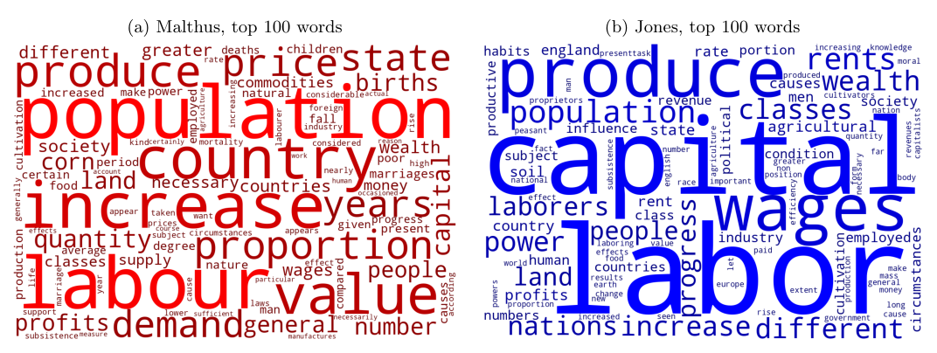
Through the lens of his theory, Malthus claimed that India's excessive level of population was to blame for agrarian distress during periods of unfavourable growing conditions, as well as the frequency with which famines struck the subcontinent. Meanwhile, Jones argued that the low incomes and sensitivity of the agrarian population to fluctuations in the weather were due instead to insufficient capital investment, rather than excessive population. These differences in emphasis are immediately apparent from a word cloud of text in their writings.
Figure 1: Word clouds, top 100 words of Malthus and Jones
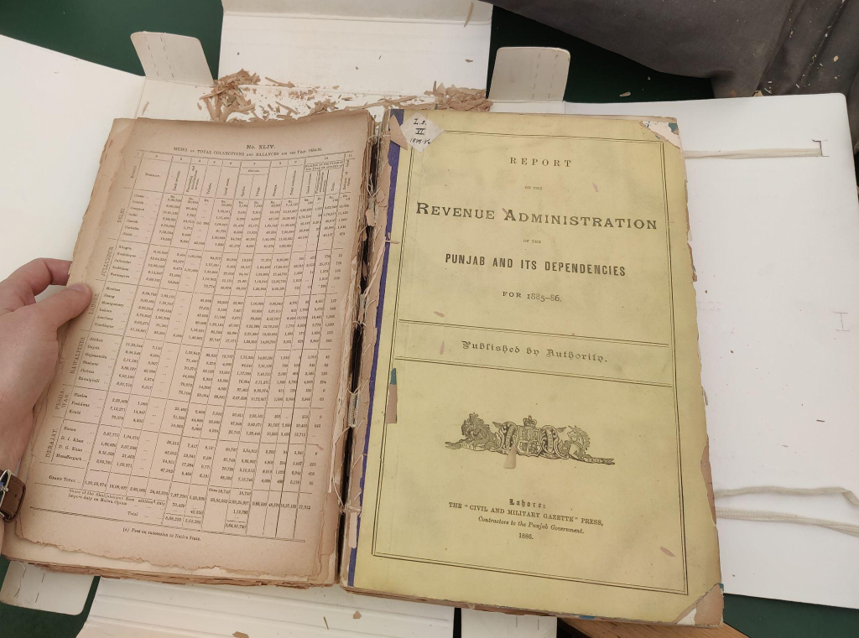
Qualitative evidence suggests that the ideas endorsed by Malthus discouraged civil servants from intervening to limit distress (Ambirajan 1976). I rely on the differences in instruction to measure the influence of these ideas to investigate this hypothesis. I digitised a vast array of archival material at the British Library in London, including information on the college cohort of civil servants and their subsequent appointments to positions across colonial India, as well as the local rainfall conditions and policies implemented in the districts of India each year over nearly four decades.
Figure 2: Example archival records at the British Library
Did Malthusian ideas matter for implementation?
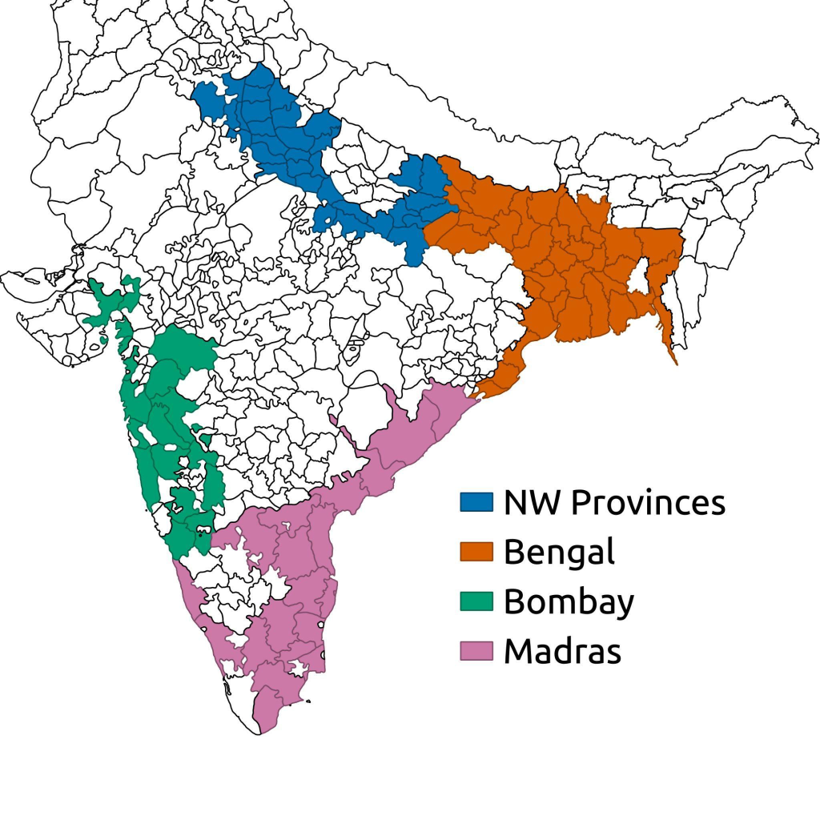
I focus on district collectors, the local officials entrusted with executive authority and overseeing local fiscal policy. My methodology relies on a simple empirical approach, which firstly leverages the timing of promotions of Jones-trained civil servants into these roles, and secondly exploits the incidence of droughts across districts in India. I compare the average relief responses of each group to droughts, with the expectation that if these ideas did influence relief policy, then Malthus-trained collectors would have provided less relief than their Jones-trained counterparts.
Figure 3: Districts and provinces administered by graduates from the college
I find that collectors who studied under Malthus provided consistently less relief during drought, with Malthus-trained officials issuing fewer tax breaks and spending less on public projects. Moreover, I find that they were less likely to open new public works, coordinate the import of food into their district, and issue new lines of credit to local cultivators. Using data from annual performance reviews, I show that Jones-trained collectors were also up to twice as likely to be named for good performance during drought, implying that the responses of Malthus-trained collectors did not align with policy priorities. These ideas, therefore, led implementation to fall short of achieving its goals.
Figure 4: Lower relief under Malthus-trained collectors during drought
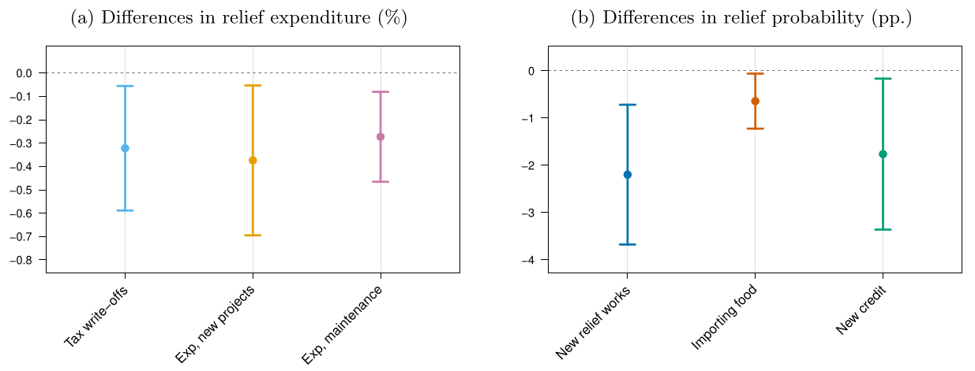
Notes: Figure plots coefficient estimates and 90% confidence intervals for average difference in Malthus-trained collector response to drought, relative to Jones-trained collectors.
Lessons for modern government
The evidence demonstrates that ideas have a real influence on civil servants, and particularly on their implementation of policy. In this case, the average differences in relief would have offered enough financial assistance to feed 40,000 citizens for two months, or roughly 5% of a district's population. Moreover, the effects I recover are remarkably persistent, affecting the decisions of bureaucrats, on average, two decades after training.
I find the largest differences during more severe rainfall shortages, among the most senior bureaucrats, and among bureaucrats who earned the fewest academic awards at the college. Modern policies to address these forces, such as training, should therefore have the greatest effects when targeted at senior officials responsible for responding to crises, and also among those selected through the least meritocratic recruitment strategies, such as patronage.
Ideas have had tremendous influence on policymakers and civil servants in the past, and there is no reason to believe their influence has faded today. The ideas of Malthus, for example, have continued to influence civil servants, including as recently as the introduction of China's one-child policy (Greenhalgh 2008). Efforts to limit the influence of ideas where they risk undermining policy goals, as Malthusian ideas did in colonial India, will make for a more responsive civil service and effective government.
References
Ambirajan, S (1976), "Malthusian population theory and Indian famine policy in the nineteenth century," Population Studies, 30(1): 5–14.
Ash, E, D L Chen, and S Naidu (2026), "Ideas have consequences: The impact of law and economics on American justice," Quarterly Journal of Economics, 141(1): 845–887.
Feldstein, M S (1981), The Retreat from Keynesian Economics, Harvard Institute of Economic Research.
Greenhalgh, S (2008), Just One Child: Science and Policy in Deng's China, University of California Press.
Irwin, D A (2025), "Trade policy, exchange rates, and the globalization surge of the 1990s," Journal of Economic History, 85(2): 303–335.
Robertson, E (2026), "Economic ideas and policy implementation: Evidence from Malthusian training in British Indian bureaucracy," Unpublished manuscript.
Rodrik, D (2014), "When ideas trump interests: Preferences, worldviews, and policy innovations," Journal of Economic Perspectives, 28(1): 189–208.