



In rural India, language barriers restrict farmers' access to digital agricultural advice, hindering technology adoption and reducing crop yields.
The modernisation of agriculture in developing nations is frequently hampered by imperfect information regarding new technologies (Foster and Rosenzweig 1995, Conley and Udry 2010). India, in particular, has an underserved demand for information among rural farmers. As recently as 2003, 60% of Indian farmers reported lacking access to any source of information regarding modern agricultural technologies (National Sample Survey 2005). Language differences between individuals impose higher transaction costs for information acquisition. The issue is particularly relevant in areas characterised by high levels of linguistic fragmentation and far from the technological frontier, such as agricultural regions.
Linguistic differences across India
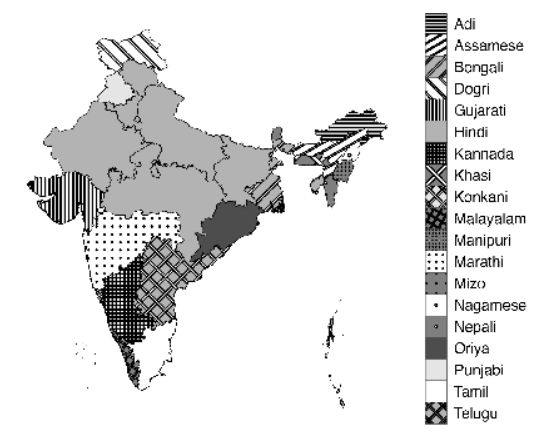
India is characterised by profound linguistic diversity. The country has 22 officially recognised languages in its Constitution and an additional 99 non-officially recognised languages, each spoken by at least 10,000 people. The level of language fragmentation in India is comparable to that of sub-Saharan Africa (Easterly and Levine 1997).
This linguistic fragmentation creates significant transaction costs for information acquisition. For farmers living far from the technological frontier, the inability to communicate seamlessly with experts can severely slow down learning about new and productive agricultural inputs.
Figure 1: Official state languages in India
The natural experiment: The Kisan Call Centres
To address the agricultural information gap, the Indian Ministry of Agriculture introduced Kisan Call Centres (KCC) in the mid-2000s. These 21 call centres offer free agricultural advice to farmers via landline or mobile phones. Calls are answered by trained agronomists who provide customised advice specific to the agro-climatic characteristics of the farmer's location.
Crucially, a key institutional feature of KCC is that the advice is only offered in the official language of the Indian state where the caller’s phone number is registered. This means only farmers speaking the official language of their state can seek advice and understand the answers provided by the local KCC agronomists. We use this feature of KCC to understand the role of information friction on technology adoption (Gupta, Ponticelli, and Tesei 2024).
Isolating the language barrier
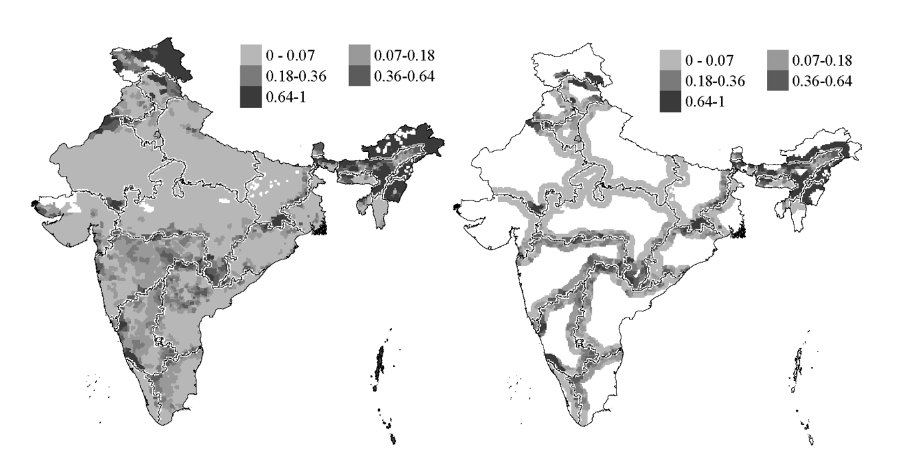
Since the State Reorganisation Act of 1956 drew state borders along linguistic lines, the diffusion of Indian languages is relatively homogeneous within states. However, the overlap between linguistic and administrative boundaries is not perfect, and the share of people whose first language is an official Indian language other than that of the state where they live tends to increase near state borders. This generates differences in potential access to the KCC service between geographically contiguous areas located across state borders.
To isolate the role of language barriers, we compared geographically contiguous areas – specifically 10 x 10 km cells – that sit across state borders before and after the establishment of KCCs. By comparing speakers of official Indian languages who have different access to the KCC platform simply because they reside on the ‘wrong’ side of a state border, we can effectively control for other socio-economic and ethnic characteristics.
Figure 2: Share of non-state official language speakers (left) vs. share of non-state official language speakers in cells within 50 kms of state borders (right)
We combined three main data sources to map farmers' queries to actual technology adoption and productivity. First, we use administrative data on calls made by farmers to the KCC between 2006 and 2017. This data provides us with the location and content of all calls, allowing us to categorise calls regarding seed varieties, pesticides, fertilisers, and irrigation as technology calls.
Second, to create measures of agricultural technology adoption, we collected data from the Agricultural Input Survey of India on the adoption of high-yielding variety (HYV) seeds, chemical fertilisers, and artificial irrigation systems. HYV seeds are highly responsive to fertilisers and require reliable irrigation, making them a crucial package of modern inputs.
Finally, we measure agricultural yields using data on area farmed and crop quantities produced from ICRISAT, as well as changes in vegetation indices estimated from MODIS satellite images.
Language barriers shape technology adoption
Our analysis reveals three main findings regarding the economic impact of language barriers in agricultural communities.
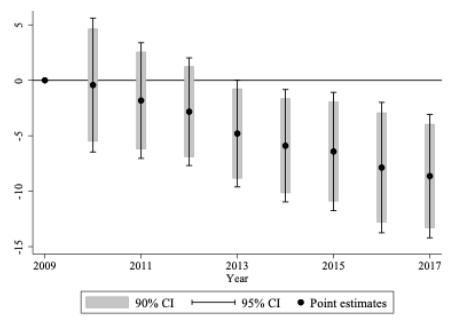
First, we find that language barriers reduced access to agricultural information among farmers. Areas with higher language barriers between farmers and agricultural advisors experienced a significantly lower increase in the number of calls to KCC following the launch of the programme. Specifically, areas with a one standard deviation higher share of non-state language speakers saw about 0.9 fewer calls to KCC per 100 farmers per year in the period after the introduction of the programme. This corresponds to 38% fewer calls than the average cell in our sample, confirming that language differences severely restrict farmers' ability to access vital agricultural information.
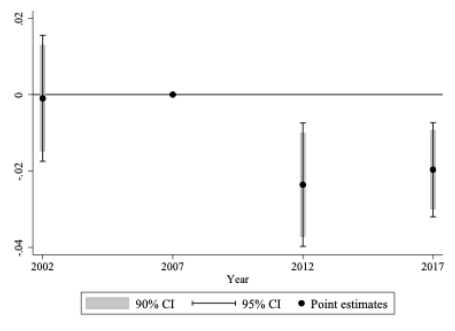
Second, we find language barriers significantly hindered the adoption of critical agricultural innovations. Areas with a one standard deviation higher share of non-state language speakers experienced a 1.7% lower adoption rate for HYV seeds. Furthermore, because HYV seeds require complementary inputs to maximise their potential, these areas also experienced a 0.5% lower increase in fertilisers and a 2% lower increase in irrigation. These negative effects materialised within five years from the introduction of KCC and persisted in the long run.
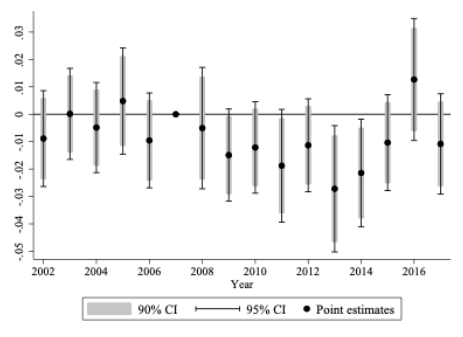
Third, we find a direct negative effect of language barriers on agricultural productivity. Areas with a one standard deviation higher share of non-state language speakers experienced 0.6% lower crop yields. While estimates using satellite-based vegetation indices were somewhat less precise, they mirrored this negative magnitude, underscoring the real-world output losses generated by information frictions.
Figure 3: Event studies
(a) Calls to KCC
(b) HYV seeds adoption
(c) Average crop yields
Policy implications: Bridging the divide
As wireless telecommunication services become increasingly available in rural areas of developing countries, so do the expectations about their ability to reduce information frictions and improve productivity (GSMA 2020). However, our results demonstrate that simply providing access to information is insufficient when significant language barriers prevail.
If policymakers fail to account for local language differences, the increasing amount of information available may inadvertently exacerbate differences in economic opportunities between those who are able to access this information and those who are not. While traditional face-to-face extension programmes have historically struggled to provide timely and personalised advice (Anderson and Feder 2004, Duflo et al. 2011), digital platforms like KCC can deliver customised information throughout the agricultural cycle.
Moving forward, policymakers must intentionally design interventions to overcome linguistic boundaries. Doing so will ensure that the fruits of digital innovation and modern technology reach the farmers who need them most.
References
Anderson, J R, and G Feder (2004), "Agricultural extension: Good intentions and hard realities," World Bank Research Observer, 19(1): 41–60.
Conley, T G, and C R Udry (2010), "Learning about a new technology: Pineapple in Ghana," American Economic Review, 100(1): 35–69.
Duflo, E, M Kremer, and J Robinson (2011), "Nudging farmers to use fertilizer: Theory and experimental evidence from Kenya," American Economic Review, 101(6): 2350–2390.
Easterly, W, and R Levine (1997), "Africa's growth tragedy: Policies and ethnic divisions," Quarterly Journal of Economics, 112(4): 1203–1250.
Foster, A D, and M R Rosenzweig (1995), "Learning by doing and learning from others: Human capital and technical change in agriculture,"Journal of Political Economy, 103(6): 1176–1209.
GSMA (2020), "Digital agriculture maps: 2020 state of the sector in low- and middle-income countries."
Gupta, A, J Ponticelli, and A Tesei (2024), "Language barriers, technology adoption and productivity: evidence from agriculture in India," Review of Economics and Statistics, 1–28.