




By making formalisation cheaper and easier, Brazil’s MEI programme helped millions of microentrepreneurs register – but delivered little in higher earnings, functioning instead as a subsidised expansion of social security access at a net fiscal cost.
For a broader synthesis of themes covered in this article, check out Issue 2 of our VoxDevLit on Informality.
Most businesses in developing countries are small and informal, raising concerns about low productivity, limited tax collection, and weak access to social security (Levy 2010, Jayachandran 2021). One common response is to make formality cheaper by reducing registration costs, simplifying taxes, and lowering compliance burdens. Yet the evidence on these policies is mixed (Ulyssea 2025), and their objectives are often blurred. Formalisation may increase firm registration without raising earnings or productivity. It may expand the tax base, or it may increase fiscal costs if newly formal workers become eligible for subsidised social security benefits. Evaluating formalisation policy therefore requires asking not only whether firms formalise, but what formality delivers once they do.
Brazil’s Microempreendedor Individual programme
Brazil’s Microempreendedor Individual (MEI) programme changed the terms of formality for very small entrepreneurs. Launched in 2009, it created a simplified legal and tax category that allowed eligible microentrepreneurs to register as formal firms. Formal status brought several potential benefits: entrepreneurs could issue invoices, access business banking and credit, and operate with legal protection against fines and inspections. Registration also gave them access to Brazil’s social security system, including maternity benefits, disability insurance, and retirement pensions. At the same time, MEI dramatically lowered the cost of becoming formal. Before the programme, registering a firm could cost around BRL 2,000 (US$385) and take about 120 days. After the full system was introduced, eligible entrepreneurs could register in a single day, at virtually no cost, with simplified bookkeeping and a low, flat tax monthly payment calculated at 5% of the minimum wage.
Formalisation increased firm registration
MEI eligibility was not universal. The government defined eligible activities at a detailed industry level, allowing many small-scale occupations, such as hairdressers, street vendors, painters, repair workers, and basic construction trades, to register under the new regime, while excluding licensed professions and more regulated sectors. This rule allows us to compare industries that became eligible for MEI with industries that did not, before and after the reform. We do so using Brazil’s national business registry, which covers the universe of formal firm registrations and allows us to track firm creation and activity month by month.
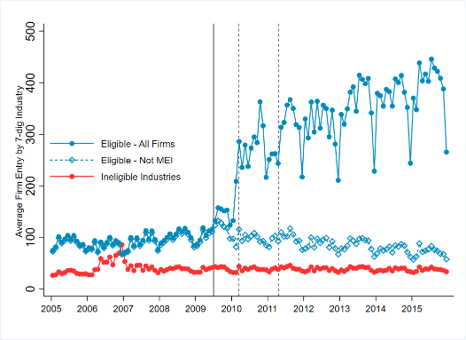
The patterns are striking and point to a sharp increase in formal business creation due to MEI. In Figure 1a, we show that new firm registrations in eligible and ineligible industries evolve similarly before MEI. Once the programme is introduced, registrations in eligible industries rise sharply. In Figure 1b, the number of active formal firms also increases steadily in eligible industries after the reform. The fact that non-MEI firms remain roughly stable is important for interpretation. If the programme mainly led existing formal firms to switch from other tax regimes into MEI, we would expect to see a decline in non-MEI firms. Instead, the evidence suggests that MEI brought new firms into the formal sector through the simplified regime.
Figure 1: Firms by industry
(a) Average number of firms registering by industry
(b) Estimates on the number of active firms by industry
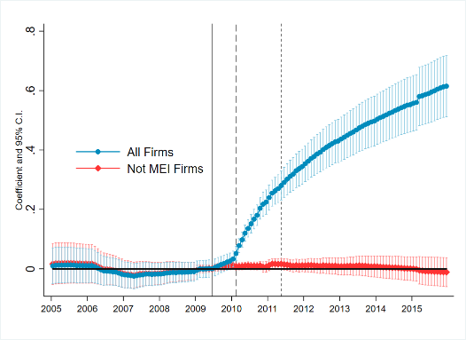
Notes: Panel (a) plots the average number of firms registering in each period across eligible and ineligible 7-digit industry codes. Panel (b) plots estimates on the log number of active firms, and the active non-MEI firms. Both figures were constructed by the authors from the Cadastro Nacional de Pessoas Jurídicas dataset.
Impact of formalisation on microentrepreneurs’ earnings
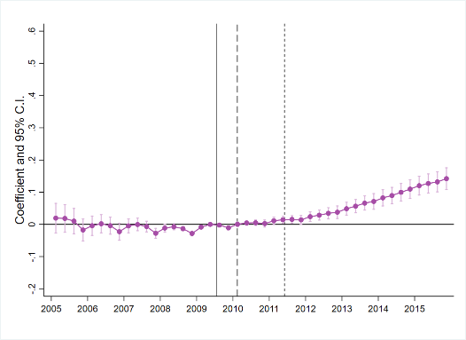
The large increase in formal business creation raises an important question: did formalisation improve economic outcomes for microentrepreneurs? The answer appears to be no. To examine this, we use household survey data, which includes both formal and informal microentrepreneurs, and aggregate the data to the industry level. Comparing MEI-eligible and ineligible industries before and after the programme, we find no evidence that average earnings increased. The estimates fluctuate around zero throughout the post-reform period, suggesting that MEI brought more microentrepreneurs into the formal sector but did not, by itself, raise their earnings.
Figure 2: Effects on labour earnings of microentrepreneurs
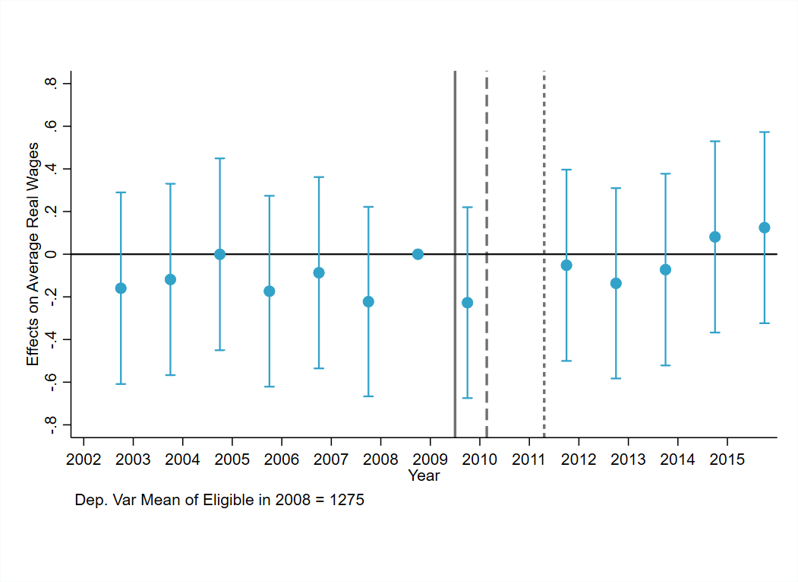
Notes: This figure shows the estimates of the programme's effects on microentrepreneurs' earnings. Constructed by the authors from the Brazilian National Household Survey (PNAD).
Social security benefits
The lack of earnings effects changes how we should interpret the programme, but it does not make MEI irrelevant. Formalisation through MEI was also a gateway into Brazil’s social security system. By registering and making monthly contributions, microentrepreneurs could become eligible for benefits such as maternity leave, disability insurance, and retirement pensions. For workers who would otherwise remain informal, this expansion of coverage can be valuable even if their businesses do not grow.
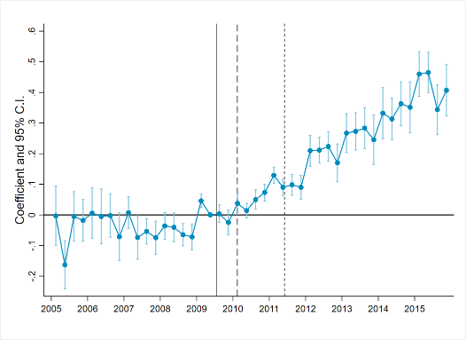
We examine this channel using administrative records on social security benefits. The comparison is no longer between eligible and ineligible industries, but between benefits received by microentrepreneurs and benefits received by workers in other occupational categories. The patterns show little evidence of pre-existing differential trends. After MEI, however, new benefits issued to microentrepreneurs increase substantially, as shown in Figure 3a. The number of active benefits also rises steadily, as shown in Figure 3b. This suggests that the programme’s main payoff was not higher earnings, but greater access to social protection among previously uncovered workers.
Figure 3: Effects on social security benefits
(a) Estimates on the number of benefits issued
(b) Estimate on the number of active benefits
Notes: Panel (a) plots our estimates of the effects of the programme on the number of benefits issued to microentrepreneurs in each quarter (flow). Panel (b) plots the effects on the number of active benefits in a given quarter (stock). Both were constructed by the authors from publicly available data on benefits by the Brazilian Institute of Social Security (INSS).
Costs and revenues to the government
These results challenge a common fiscal argument for formalisation. Bringing informal workers into the formal sector is often expected to increase government revenue. In the case of MEI, this did not happen. The programme brought millions of microentrepreneurs into the formal system and generated new contributions, but those contributions were too small to offset the increase in social security spending. By 2015, MEI raised almost BRL 800 million in revenue while generating around BRL 2 billion in additional benefit payments. In other words, each Brazilian real collected through the programme was associated with BRL 2.56 in new social security costs. Formalisation through MEI therefore did not strengthen fiscal capacity, but operated instead as a subsidised expansion of social insurance to workers who had previously been outside the system.
Policy implications: Formalisation
How, then, should we evaluate MEI? Our fiscal calculation shows that the programme did not pay for itself. But this does not mean that resources were wasted. The additional spending took the form of social security benefits received by microentrepreneurs who were previously outside the formal system. To account for this, we use the Marginal Value of Public Funds framework, which compares how much beneficiaries value the policy with its net cost to the government. Under a simple benchmark in which beneficiaries value each Brazilian real of social security benefits at one real, we estimate an MVPF of 1.64. This means that the value received by microentrepreneurs exceeds the net fiscal cost of the programme. MEI was therefore not successful as a revenue-raising policy, and it did not raise earnings or firm growth. But it was valuable as a subsidised expansion of social insurance to informal workers.
Looking forward, the central question is not whether governments should include microentrepreneurs in social security systems, but how they should do so. MEI shows that a simplified and subsidised regime can bring many informal workers into the formal system and expand access to valuable benefits. But it also shows that the fiscal design matters. Could contributions be somewhat higher, or benefits phased in differently, without sharply reducing take-up? Could the subsidy be targeted more directly to workers with the greatest need? And how should governments balance contributory social insurance with broader non-contributory programmes for workers who remain informal? Our study advances this debate by showing both the promise and fiscal limits of simplified formalisation regimes. The broader challenge is to move from asking whether simplified regimes can formalise workers to asking how these regimes should be optimally designed, balancing take-up, social protection, and fiscal sustainability.
References
Farias, A, and R H Rocha (2026), "Formalizing microentrepreneurs through targeted tax systems: Evidence from Brazil," Journal of Public Economics, 259: 105677.
Jayachandran, S (2021), "Microentrepreneurship in developing countries," in K F Zimmermann (ed.), Handbook of Labor, Human Resources and Population Economics, Springer: 1–31.
Levy, S (2010), Good Intentions, Bad Outcomes: Social Policy, Informality, and Economic Growth in Mexico, Rowman & Littlefield.
Ulyssea, G, M Bobba, L Gadenne, and M Harari (2025), "Informality," VoxDevLit, 6(2).