





College students in sub-Saharan Africa can be as food insecure as the ultra-poor, but modest financial support may yield large returns for wellbeing.
Sub-Saharan Africa is home to a growing share of the world's young people. By 2040, one in three people aged 18–25 will live in the region (United Nations 2024), and by mid-century it is projected to supply nearly 80% of the growth in the global labour force (Pritchett 2026). As primary and secondary schooling has expanded (Lucas and Mbiti 2012), demand for higher education in sub-Saharan Africa has risen, and gross tertiary enrolment has grown to as much as 20% in some countries. Education is, in turn, among the more reliable engines of long-run growth (Gethin 2025).
Yet we know remarkably little about these students. Until recently they were a vanishingly small part of the population, and they were widely assumed to be children of the wealthy elite, irrelevant for development policy (Salmi and Bassett 2014, Ilie and Rose 2018). A lack of data reinforced this blind spot: nationally representative surveys rarely capture young people who have left home to study, African universities collect little administrative data on socioeconomic status, and few researchers intentionally studied them. Of the 66 studies funded by J-PAL's post-primary education initiative, only four concern higher education, and none are in sub-Saharan Africa.
To address this gap, we launched a research project at the University of Zambia (UNZA), Zambia's flagship public university (Bau, Low, Simona, and Steinberg 2026). We combine administrative data on educational outcomes and enrolment with high-frequency mobile-phone-based surveys to capture consumption, food security, mental health, and financial wellbeing. This data suggests that, contrary to common perceptions, students struggle financially at university and that financial support for this population could enhance both equity and efficiency.
Who attends university in sub-Saharan Africa
We find that students who attend UNZA are positively selected relative to the Zambian population but far from uniformly rich. Three in ten have fathers with primary education or less, and a quarter grew up in a traditional mud house, a standard marker of poverty. For comparison, at selective American universities, only about a fifth of students come from the poorest 60% of households (Chetty et al. 2020).
As deprived as the ultra-poor
How these students live is even more striking than where they come from. A third report eating fewer than two meals a day — a higher share than among Zambian households that describe themselves as 'very poor' or among Kenyan households poor enough to qualify for GiveDirectly's cash transfers, which target extreme poverty. By several measures of food insecurity, students are more deprived than the region's poorest households (Figure 1).
Figure 1: Food insecurity among UNZA students and comparison households
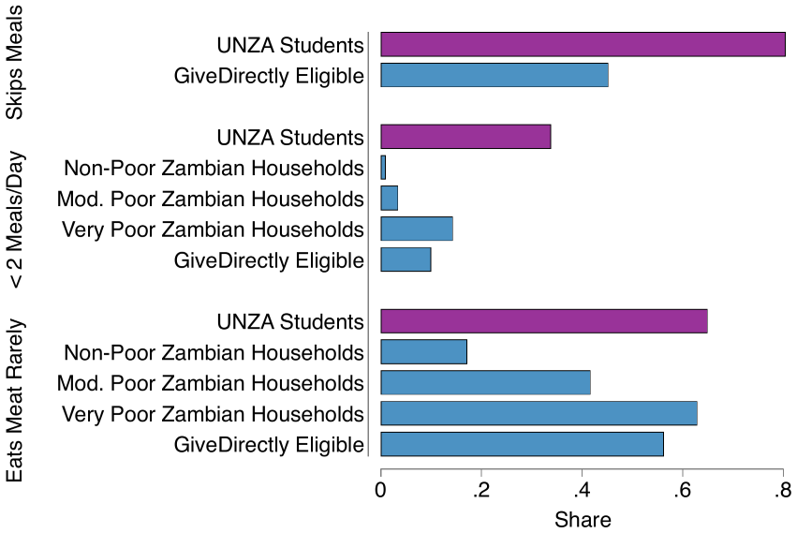
Note: Share reporting each measure. Comparison groups are Zambian households by self-reported poverty (LCMS) and GiveDirectly-eligible households in Siaya County, Kenya (Egger et al. 2022). 'Skips meals' = sometimes or often; 'eats meat rarely' = rarely or never.
Their finances are precarious. Most borrow each month even though students lack access to long-term formal-sector loans to finance their education. They borrow from friends, as well as mobile-money apps and moneylenders charging 7–20% a month. Nine in ten could not raise US$57 (1,500 Kwacha) in an emergency. One in five report having done 'something they were not proud of' to raise money, wording designed to capture transactional sex, a well-documented coping strategy among young women in the region (Dupas 2011). On standard screening tools, most show signs of anxiety and depression, worse than among American college students or samples of adults in sub-Saharan Africa living in poverty.
Students as migrants
Why are students at a flagship university so poor? Many come from rural farming households that grow enough to eat but hold little cash. Moving to Lusaka, an expensive capital city, cuts them off from home-grown food and family support while raising their cost of living. In this way, they resemble rural-to-urban migrants, who bear the costs of moving but cannot yet capture the returns (Munshi and Rosenzweig 2016). Our high-frequency data illustrates this point: students become markedly more food secure the moment they go home for a break and slip back within weeks of returning to campus (Figure 2). Because the pattern recurs across two breaks in different seasons, it is not due to seasonality or measurement error. Being at school, and bearing increased living costs that must be paid in cash, largely produces this hardship.
Figure 2: Food security over the academic year
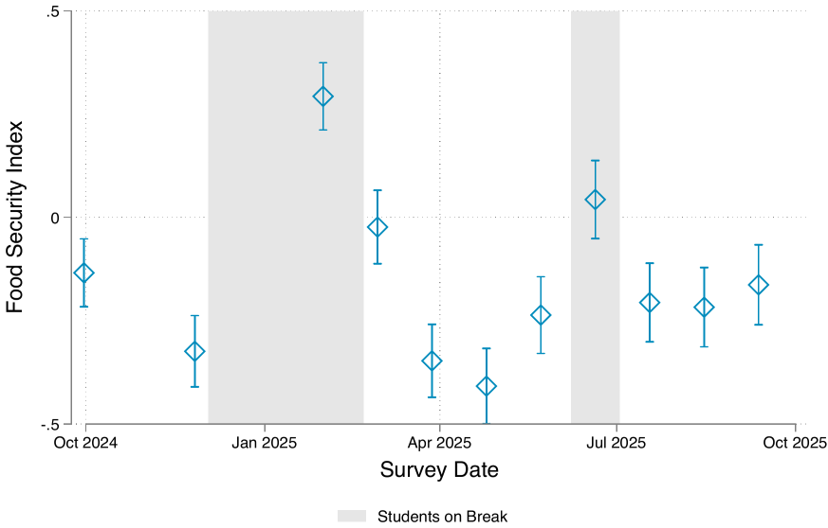
Note: Food security index by survey date (control group); higher values indicate greater food security. Shaded bands mark periods when students were home on break.
The impact of financial support for college students
If cash is a binding constraint, financial support could help. We test this using the near-random allocation of scarce on-campus housing. Housing is a substantial benefit since recipients pay far below market rents and can sublet rooms for income. Students who receive housing become more food secure, report less financial distress, and are 10–12 percentage points more likely to pass all their courses (Figure 3). The gains are about twice as large for the most disadvantaged students, from rural districts or mud homes. Students who merely live on campus without the financial benefit see no such improvement. Money, rather than the location, matters.
Figure 3: The effect of on-campus housing on student outcomes
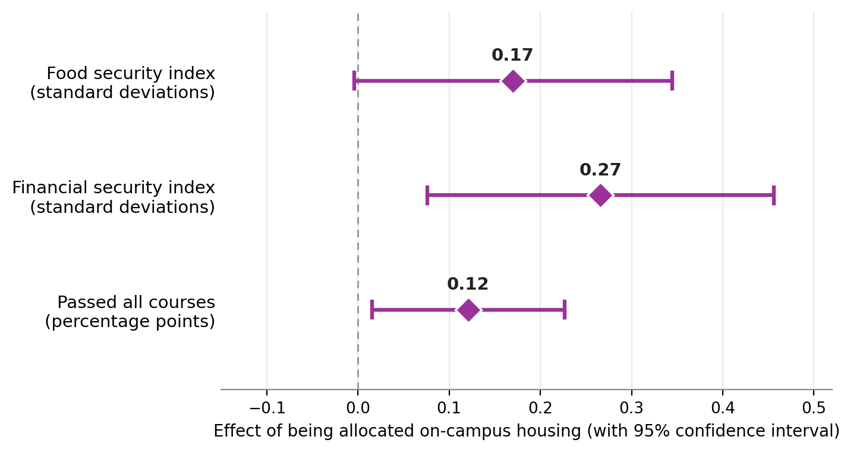
Note: Estimated effect of being allocated on-campus housing on each outcome, with 95% confidence intervals (preferred specification). Controls for student characteristics are chosen using double lasso. Passing all classes is measured in UNZA's administrative data. Markers to the right of the line indicate improvement; intervals that do not cross the line are statistically significant.
Large returns, even untargeted
Using the effect on passing classes, we infer effects on dropout and repetition based on how passing classes predicts trajectories throughout college. This exercise suggests that the benefits of financial support during college could be large relative to the costs, even if we ignore the direct effects on wellbeing while in college. Counting only future wage gains (calculated based on others' estimates of the returns to tertiary education in sub-Saharan Africa), and ignoring the health, intergenerational, and broader economic benefits of education, housing-equivalent financial support yields a social benefit–cost ratio of about 3.3 and a marginal value of public funds of around 6. These numbers are comparable to some of the most cost-effective interventions in poor countries (Duflo et al. forthcoming). Even crude targeting, by rural origin or childhood housing type (e.g. growing up in a mud house), both already known to administrators, roughly doubles the benefit–cost ratio. If students fully repaid educational loans, the policy would pay for itself from the government's perspective. Our findings echo existing evidence that cash support can raise food security, wellbeing, and human capital among the poor (Crosta et al. 2025). However, we show these results extend to a novel population. Students who are often regarded as elites turn out to resemble cash-poor migrants, precisely those for whom credit constraints bind hardest. Moreover, cash does not just increase this group's contemporaneous wellbeing. This group may also be an attractive target for impact in the parlance of Haushofer et al. (2025).
Implications for higher-education policy
In rich countries, formal-sector loans against future earnings, subsidised loans, and heavily subsidised public universities help solve the problem of liquidity constraints during college. In sub-Saharan Africa, liquidity constraints are tighter: the largest government loan does not cover food and housing on top of tuition, and private credit is punishingly expensive. Students have no access to long-term educational loans from banks. As enrolment expands and an increasing share of the world's young people grows up in the region, building a university system that works for non-elite students is not only fairer but, our results suggest, among the more impactful investments a government can make. Modest, well-targeted financial support during university could improve equity, set students' lives on a permanently better trajectory, and ultimately foster economic growth.
References
Bau, N, C Low, S Simona, and B Steinberg (2026), "The precarious financial lives of college students in sub-Saharan Africa," Unpublished manuscript.
Chetty, R, J N Friedman, E Saez, N Turner, and D Yagan (2020), "Income segregation and intergenerational mobility across colleges in the United States," Quarterly Journal of Economics, 135(3): 1567–1633.
Crosta, T, D Karlan, F Ong, J Rüschenpöhler, and C R Udry (2025), ”Unconditional cash transfers: A Bayesian meta-analysis of randomized evaluations in low and middle income countries,” Unpublished manuscript.
Duflo, E, P Dupas, E Spelke, and M P Walsh (forthcoming), "Intergenerational impacts of secondary education: Experimental evidence from Ghana," American Economic Review.
Dupas, P (2011), "Do teenagers respond to HIV risk information? Evidence from a field experiment in Kenya," American Economic Journal: Applied Economics, 3(1): 1–34.
Egger, D, J Haushofer, E Miguel, P Niehaus, and M Walker (2022), "General equilibrium effects of cash transfers: Experimental evidence from Kenya," Econometrica, 90(6): 2603–2643.
Gethin, A (2025), "Distributional growth accounting: Education and the reduction of global poverty, 1980–2019," Quarterly Journal of Economics, 140(4): 2571–2618.
Haushofer, J, P Niehaus, C Paramo, E Miguel, and M Walker (2025), "Targeting impact versus deprivation," American Economic Review, 115(6): 1936–1974.
Ilie, S, and P Rose (2018), "Who benefits from public spending on higher education in South Asia and sub-Saharan Africa?," Compare: A Journal of Comparative and International Education, 48(4): 630–647.
Lucas, A M, and I M Mbiti (2012), "Access, sorting, and achievement: The short-run effects of free primary education in Kenya," American Economic Journal: Applied Economics, 4(4): 226–253.
Munshi, K, and M Rosenzweig (2016), "Networks and misallocation: Insurance, migration, and the rural-urban wage gap," American Economic Review, 106(1): 46–98.
Pritchett, L (2026), "Global labor mobility between shrinking and growing labor forces," Journal of Economic Perspectives, 40(1): 71–92.
Salmi, J, and R M Bassett (2014), "The equity imperative in tertiary education: Promoting fairness and efficiency," International Review of Education, 60(3): 361–377.
United Nations (2024), World Population Prospects 2024, Department of Economic and Social Affairs, Population Division.