

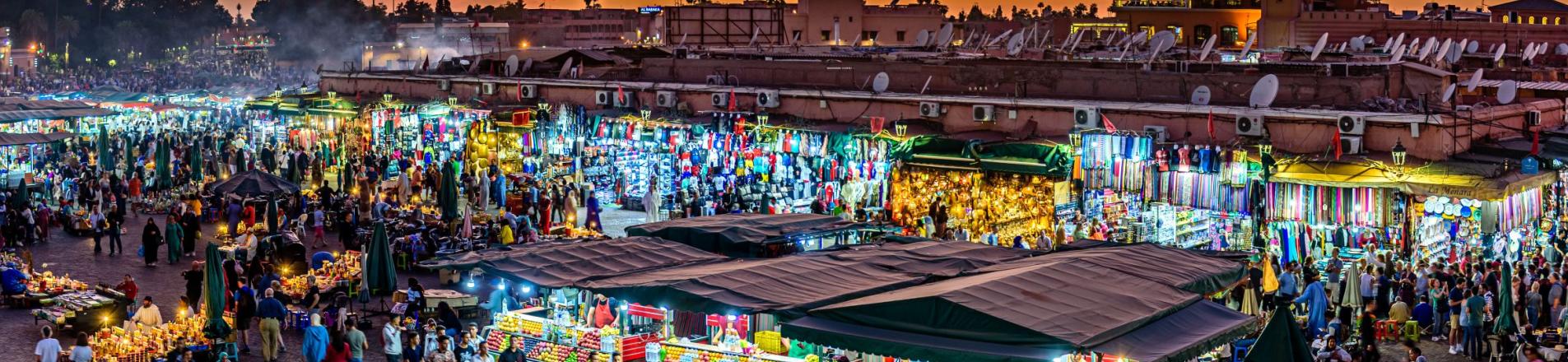

The informal economy – accounting for 30–90% of the labour force across developing countries – remains largely invisible to governments, undermining tax revenue, productivity, and long-term growth, and requires a combined strategy of easing formalisation costs while raising enforcement.
What is the informal economy, and why does it matter?
In many developing countries, between 30% and 90% of workers are employed in the informal sector – running legal businesses or working jobs that exist outside government regulation and taxation.
In this episode of Economics Unpacked, Gabriel Ulyssea explains why informality is so widespread, how it affects economic growth, inequality and public services, and why simply cracking down on informal businesses often makes matters worse. Drawing on his research, he explores why the informal economy is often a symptom of deeper institutional problems and what governments can do to encourage more workers and firms to join the formal sector.
Whether you're studying economics, interested in development policy, or simply curious about how economies work, this episode explains one of the biggest – and least visible – parts of the global economy.
Transcript
What if a huge part of the economy was hiding in plain sight, invisible to the government? It's called the informal economy.
Gabriel Ulyssea: The informal sector is this massive part of developing countries' economies that take place at the margin of all laws, regulations, and legal frameworks. In developing countries, this accounts for a vast share of workers. In Latin America, that ranges from 30–80% of the labour force. In sub-Saharan Africa, that can go up to almost 90–95% of the labour force.
So the informal economy is anywhere from 30–90% of the economy. How can this be possible? What's the consequence of such a large informal economy? And what can be done about it?
Welcome to Economics Unpacked.
Gabriel Ulyssea: So the informal sector is every part of the legal economy, meaning it's not criminal activities. So these are legal activities such as mom-and-pop shops, small textile manufacturers, all legal economic activities that are invisible to the government because they are not registered to pay taxes, they are not complying with the labour regulations. When you have so many firms and so many workers in the informal sector, they effectively are invisible to the government, and the government therefore cannot, for example, tax them. Now you might think, well, this is actually a good thing, and it might be potentially a good thing individually for a given worker or given firm, but on the aggregate, collectively, that's very bad news for the economy, because that means that the government doesn't have the ability to raise the resources that it needs to finance, for example, health expenditures or providing high-quality education, and these are, for example, two things that are crucial for the welfare of the population but also for long-term growth.
The informal sector also creates the wrong incentives for economic growth.
Gabriel Ulyssea: It provides bad incentives for both workers and firms in terms of, say, firm growth. In order to remain informal, firms cannot grow too much, because otherwise they become too visible to the government, that saves on taxes, but it creates this problem that, dynamically, you're not growing, you're not investing, you're not becoming more productive. And when you have too many firms in the economy in this sort of distorted regime, that means that the economy as a whole also will not experience productivity gains on the whole, and will grow less, and will have lower levels of living standards. So that's a major concern in developing countries.
The informal sector also includes housing.
Gabriel Ulyssea: Today there are over 1 billion people living in slums or informal settlements around the world. This is obviously concentrated in developing countries, but it accounts for more than a quarter of all people living in urban areas. In some countries, like in sub-Saharan Africa, the share of people living in slums can be as high as 60%. The property rights are not well defined – people don't own their houses. They rent their houses in a very informal setting. So that means that typically these are very low-quality, poor settlements that often entrap people in a cycle of poverty.
How does the invisible economy create a challenge for economic analysis and policy?
Gabriel Ulyssea: Today there is no economic issue or policy discussion in developing countries that one can approach completely ignoring the informal sector. Even if one does not have the data to analyse what's going on in the informal sector with informal workers and informal firms, one still has to consider and acknowledge the presence of this massive sector. Otherwise, policies can have massive unintended consequences and lead to adverse effects. Your conclusions can go almost in the opposite direction if you were to include the informal sector. I started working on this because, to me, it was striking – being from Brazil, and the informal sector being such a massive presence in that economy – that we had so little work done in mainstream economics, in development economics, studying this. And then the data that existed around the world suggested that that was the same in all low- and middle-income countries.
Here's an example: when looking at minimum wages.
Gabriel Ulyssea: Let's say you're trying to understand the effects of the minimum wage in a developing country's labour market, and you're focusing only on the formal sector. You might see that when you introduce the minimum wage, actually wage inequality in the formal sector declines, because you're making the low-wage earners better off. But if you don't have data on the informal sector, and if your model does not include the informal sector, you might miss completely the fact that many people will transit from formal to informal jobs. And in fact, you might make overall wage inequality in this country worse, because you're increasing the distance between formal sector workers and informal sector workers.
What's causing the large informal sector in developing countries?
Gabriel Ulyssea: One key big-picture message that comes out of the research on informality. Well, the first thing to consider is it's a symptom of badly designed regulations and institutions. So just promoting more enforcement, which means increasing inspections, making life in the informal sector a lot harder, can actually make things worse. The informal sector is also causing a lot of problems because it creates a huge reallocation of resources that should be in more productive formal firms away from these firms and into less productive informal firms. So that's also hurting the economy. So the ideal combination would be to reduce the costs of being formal; for example, by reducing all the bureaucracy that individuals have to go through in order to open a formal business, or to reduce the tax burden once you're formal. But together with that, you also have to increase enforcement. You have to increase inspections. You have to make life in the informal sector more difficult.
Why are governments not doing that? They actually have the technology, they have the ability to do that. One key thing most likely is the political costs of doing that, because associated to higher enforcement, there are always high social costs in the short run. Many of these individuals, these informal entrepreneurs, would not be able to find jobs in the formal sector immediately. They might experience long spells of unemployment. So all of that can generate high social costs and high political costs, and that's one of the main challenges today in tackling these high informality levels in developing countries.
So how to change this?
Gabriel Ulyssea: So one key dimension that is very much overlooked in the economics research about the informal sector is the fact that informality, associated to all these countries, are now in a type of equilibrium where the social costs of being informal are very low or zero. What I mean by that is that no one is ashamed of not complying with certain laws and regulations, because they are seen as useless or they are seen as inconsequential, and that contributes to reinforcing this perpetuation of high levels of informality. Whereas you have actually other countries, typically richer, more developed, where the social costs of non-compliance are quite high. You wouldn't be seen with good eyes by your neighbours or friends if you evade your taxes, you don't comply with your council tax, etc. So in that sense there are multiple possible equilibria in these economies, and even with the existing resources, if everybody agreed that not paying taxes is a bad thing, this in itself would create a reinforcement such that everybody would be complying and paying taxes, even though with the same environment around them. So this dimension is key, but it has not been studied in economics. One reason for that is it's extremely hard to find data to support this analysis.
So what's the takeaway?
Gabriel Ulyssea: I think the first basic takeaway is that informality is a symptom of other underlying issues – it's an outcome, as is high unemployment, and it should be seen as such. So then what we need to do is basically tackle this head-on: increasing the costs of informality and reducing the cost of being formal, and increasing the benefits of formality, even if it may lead to short-run costs, because in the longer run the whole society will be better off.
You can find out more about this research in our VoxDev Lit link in the description. You've been watching Economics Unpacked. If you enjoyed this episode, please like, share, subscribe.