


A field experiment in Colombia found that disclosing the identity-based criteria used to select students for a free training programme reduced enrolment, suggesting that how targeted invitations are framed shapes whether intended beneficiaries actually participate.
Editor’s note: The author has made slides available here.
Targeted programmes are a core tool of development policy. Governments, universities, NGOs, and firms use them to direct scarce opportunities towards people who have historically faced barriers to access. Social assistance systems identify poorer households; universities use scholarships and outreach to widen access; training providers often prioritise women, low-income students, rural students, ethnic minorities, or first-generation college students.
Policy debates usually focus on who should be eligible, with recent research showing how data can improve targeting and how quotas can widen higher education access (Haseeb and Vyborny 2022, Najam 2024). Less discussed is a second question: how should eligible people be told that they have been selected?
This question matters because invitations do more than provide information, they also shape how accepting an offer feels. Programme providers may highlight the identity or disadvantage that made someone eligible to signal inclusion, yet the same message can make a student feel labelled. If joining seems to signal that others see the student as less capable, as someone to be pitied or chosen because of identity rather than ability, they may feel inclined to decline a valuable opportunity.
Testing identity labels in Colombia
In Munoz (forthcoming), I study this question using a field experiment with 4,831 students in Colombia. My results show that disclosing that eligibility was identity-based reduced take-up even when the programme was free, useful, and aimed at the students being invited.
The experiment took place through a collaboration between a Colombian university and an international university partner. The programme offered a free online course designed to help students set goals, plan, and follow through. It was relevant across majors and years of study, and students who completed it received a certificate from the international partner.
Using administrative data, the students that were invited belonged to at least one group that the programme aimed to support: women, low socio-economic status students, ethnic minority students, first-generation college students, or students from rural areas. Selected participants received a personalised invitation to enrol, with the experiment only changing how much the invitation revealed about why the student had been selected.
In the ‘no-label’ condition, neither the student nor anyone else was told that group identity had played a role in the invitation. In the ‘public-label’ condition, both the student and a third party involved in registration knew that group identity was one reason for the invitation. In the ‘private-label’ condition, the student knew this, but no one else did. This middle condition helps separate the effect of knowing the reason privately from the effect of knowing that someone else also knows. The programme, eligible population, and targeting rule were therefore held fixed; only the visibility of the identity label changed.
Public labels made students less likely to join
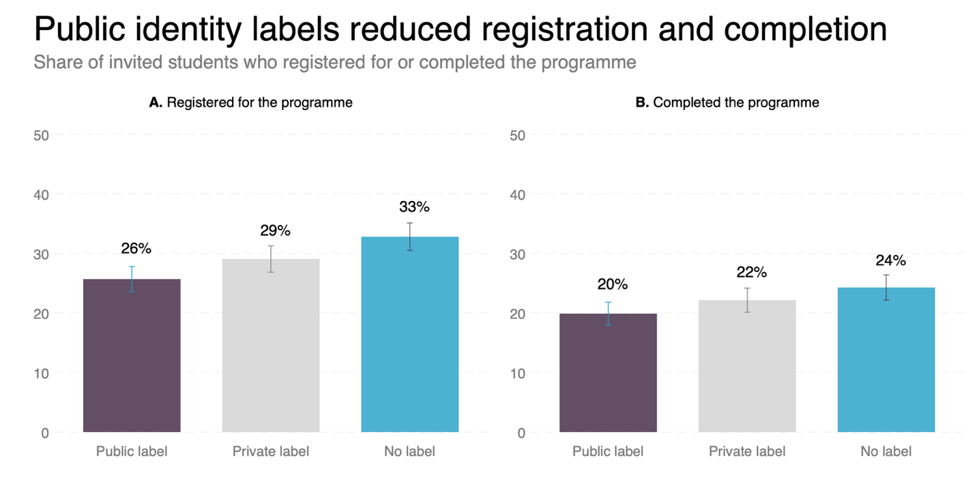
Figure 1 shows the main result: participation was lowest when the identity label was public and highest when it was not disclosed. In the public-label condition, 26% of invited students registered for the programme. When the same targeted students were invited without anyone being told why they were eligible, 33% registered. Not disclosing the identity-based criteria therefore increased take-up by seven percentage points, or 27% relative to public disclosure.
The private-label bar lies between the two. This suggests that students reacted to what they learned privately and to the possibility that someone else would attach meaning to the offer. Visibility beyond the student appears to have amplified the deterrent.
Panel B of Figure 1 shows the same pattern for completion. Completion rose from 20% in the public-label condition to 24% in the no-label condition. Once students registered, however, progression through the course was similar across conditions. The main barrier was not persistence after enrolment, but the initial decision to join.
Figure 1: Public identity labels reduced registration and completion
This was not just a change in registration numbers. Administrative records indicate that students who completed the training later performed better academically. The public label therefore discouraged some intended beneficiaries from taking up a programme that could have helped them.
Why labels changed how the offer felt
Why did the label deter students? One possibility is that mentioning group identity made the programme look less valuable. Another is that it changed the social meaning of accepting the offer. Three further experiments with 1,113 students from the same university help distinguish between these explanations. Students were shown versions of the invitation and asked about the perceived value of the programme and the likely social meaning of receiving the offer.
Figure 2 shows two things. First, the identity label did not reduce perceived value: students rated the course around 8.9 out of 10 whether or not the label appeared. Second, the label raised expected social costs. Expected pity rose from 16% to 30%, concern about being stereotyped from 7% to 14%, and expected social judgement from 14% to 21%.
Figure 2: Identity labels raised social costs, not doubts about programme value
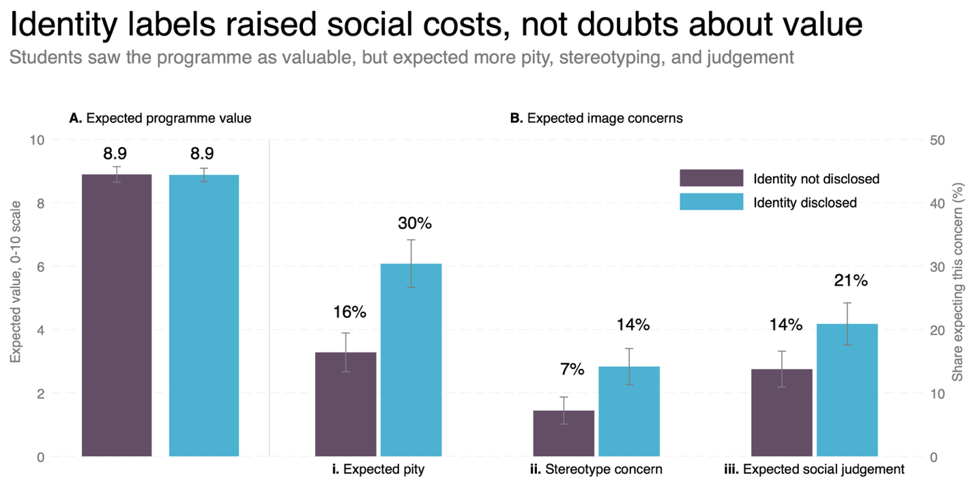
Figures 1 and 2 point to the same barrier: the label did not make the programme seem less useful, but it made accepting the offer feel more socially exposed. This is consistent with broader evidence showing that stigma and social image can shape take-up decisions (Moffitt 1983, Bursztyn and Jensen 2017). In this setting, the cost came from the label attached to the opportunity.
Use data to target, not to label students
The lesson for policy is not to abandon targeted support or affirmative action, but to separate how institutions choose beneficiaries from how they communicate with them. Administrative data can identify who should be prioritised, but an invitation need not tell a student that they were selected because they are female, low-income, rural, first-generation, or from an ethnic minority group. Providers can use this information in the background while sending messages that emphasise the quality of the opportunity, guaranteed place, steps to enrol, and benefits of participation.
This preserves the goal of reaching under-represented groups while reducing the social cost of accepting help. Students do not have to present or explain the identity that makes them eligible. Instead, the targeting happens in the background while the invitation focuses on the opportunity. However, identity-based targeting should not disappear from programmes entirely. Some programmes are designed to build community or provide role models, and participants may value knowing that an opportunity is for an under-represented group. The real question is whether identity-salient invitations encourage participation or deter the very people they are meant to reach. For many education, training, scholarship, and financial aid programmes, a simple alternative is available: use data to target support, but use neutral and respectful language to invite students. Providers should also test messages before scaling.
My evidence from Colombia suggests these choices are not cosmetic – they can determine whether the intended beneficiaries participate at all. Targeted programmes aim to expand opportunity, but eligibility is not enough – accepting help must also feel dignified. A targeted programme should not make participation feel like wearing a label.
References
Bursztyn, L, and R Jensen (2017), "Social image and economic behavior in the field: Identifying, understanding, and shaping social pressure," Annual Review of Economics, 9: 131–153.
Haseeb, M, and K Vyborny (2022), "Data, discretion and institutional capacity: Evidence from cash transfers in Pakistan," Journal of Public Economics, 206: 104535.
Moffitt, R (1983), "An economic model of welfare stigma," American Economic Review, 73(5): 1023–1035.
Munoz, M (forthcoming), "Publicly targeting group identities impacts take-up of educational opportunities," Economic Journal.
Najam, R (2024), "Closing the gap: Effect of a gender quota on women’s access to education in Afghanistan," Economics of Education Review, 99: 102509.