



Evidence from the Northern Triangle and Mexico shows that an increase in the supply of weapons raises homicidal violence, which subsequently drives migration. Notably, this effect persists even when weapons are transferred through proper legal protocols and are unlikely to fall into the hands of criminals.
Editor's note: For a broader synthesis of themes covered in this article, check out our VoxDevLit on Organised Crime.
In recent years, the US Southwest border has seen an unprecedented surge in activity. Migration flows and apprehensions reached historic highs, exceeding two million people annually in 2022, 2023, and 2024 (CBP 2025). Figure 1 displays the data for the 2008–2021 period. While economic opportunity and family reunification are often cited as primary drivers, recent research highlights a more volatile 'root cause': the nexus of global weapon supplies, local violence, and the desperate decision to flee.
Until recently, El Salvador and Honduras ranked among the most violent countries in the world (UNODC 2026). Violence, and its close link with organised crime, hinders economic development (Melnikov et al. 2025). While El Salvador has since experienced a drastic and rapid decline in violence, becoming one of the safest countries in the region, the unique conditions driving this reduction make it difficult to replicate. Nevertheless, this sharp drop in violence has successfully curbed migration from El Salvador to the US border (Abreha et al. 2025). This stands in contrast to Mexico, where spillover effects from ongoing drug violence continue to drive migration upward (Orozco-Aleman and Gonzalez-Lozano 2018).
Figure 1: Apprehensions at the Mexico-US border
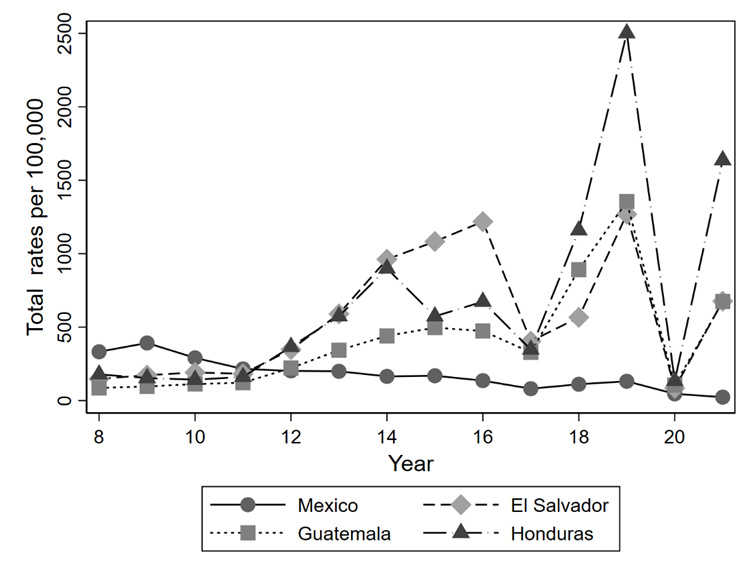
Notes: This figure displays the apprehension rates at the Mexico-US border per 100,000 people using data from Customs and Border Patrol for the 2008–2021 period.
The hidden trigger: Global weapon supply shocks
It is often assumed that violence in Mexico and the Northern Triangle (El Salvador, Guatemala, and Honduras) is purely a local issue. However, the research reveals that these regions are deeply sensitive to the global supply of weapons.
In recent work, I study shocks to the global supply of weapons to identify the impact of violence as a driver of migration from the Northern Triangle and Mexico to the US (Acuna 2026). By analysing quarterly data from the United States International Trade Commission on US weapon exports to the whole world – which account for 40% of the global market – my research shows a clear 'first-stage' effect: a 1% increase in the supply of weapons raises homicidal violence in the Northern Triangle and Mexico by approximately 0.34%. Paradoxically, these weapons are often transferred through official legal protocols intended to keep them in 'the right hands'. Instead of deterring crime, this increased availability appears to fuel cycles of escalation between national institutions and powerful criminal organisations.
The evidence behind the link
What makes this connection so certain? I conducted multiple 'placebo' tests to confirm the findings were not a coincidence. First, I find that these effects are specific to homicides. The weapon shocks specifically increased homicide rates but had no impact on other crimes such as kidnapping, robbery, or extortion. Second, I find that the effects are independent of economics. These shocks were not correlated with the health of the US economy or local economic cycles, which shows that the resulting migration is a direct reaction to the fear of lethal violence, rather than a byproduct of a failing economy.
How violence accelerates the decision to move
Figure 2 displays my key result demonstrating how migration reacts to a 1% increase in the homicide rate by using Local Projections. First, there is a peak: following a violence shock, migration typically peaks seven to eight quarters (about two years) later. Second, the magnitude of the effect varies over time. At its peak, the 'elasticity' of migration is roughly 0.7–0.84, meaning a significant rise in homicide rates leads to a nearly proportional spike in border encounters. Third, the long-term pattern is counterintuitive. Interestingly, these effects are transitory; over a 16-quarter (four-year) horizon, the net impact on migration returns to zero.
This suggests that violence precipitates the decision to move, forcing people who might have eventually migrated to do so much sooner than planned to escape immediate danger. But it could also force those who never thought about migrating to leave. However, it does not appear to raise migration to permanent, higher levels.
Figure 2: Effect of homicidal violence on migration
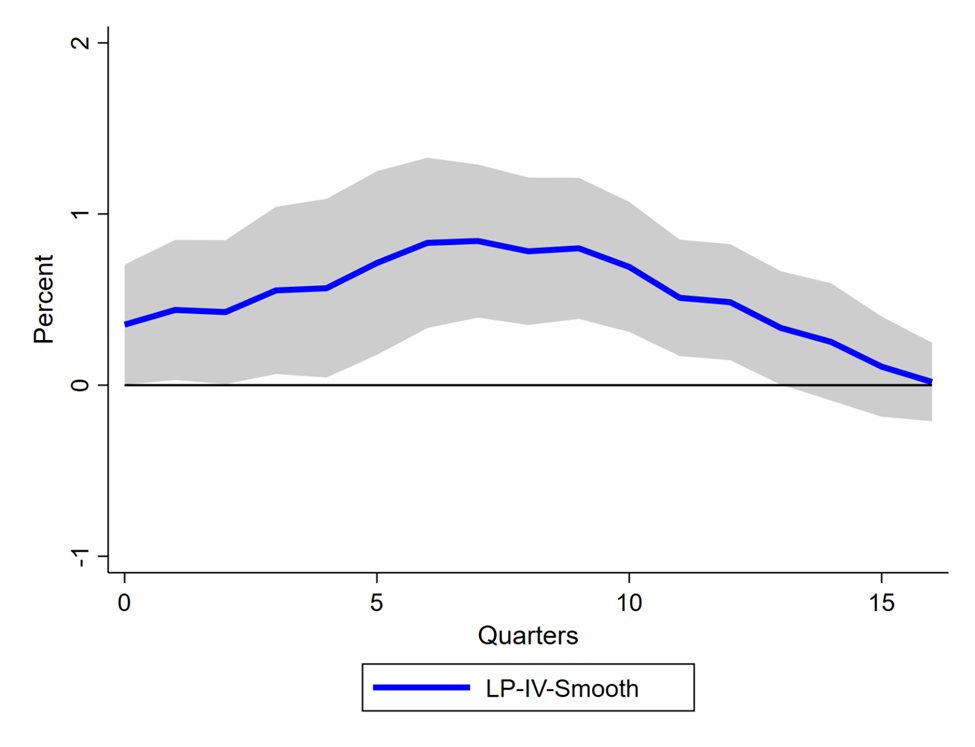
Notes: Dynamic response of apprehensions at the Mexico-US border to homicide shocks. The figure evaluates the impact of a one percent shock to homicide rates on apprehensions at the Southwest border over 16 quarters. LP-IV refers to local projections IV. Confidence bands use Driscoll-Kraay standard errors.
Who is fleeing?
My research finds significant differences in how quickly various groups respond to these shocks. Adults respond most rapidly to violence, as they often have more mobility and a greater ability to navigate the journey to the border, while children and unaccompanied minors show a much more delayed and less sensitive response. Their migration choices are often less planned and more hindered by 'friction' or obstacles, standing in contrast to the more immediate reactions of adults.
There are also regional differences. The Northern Triangle is far more responsive to violence shocks than Mexico. In Mexico, individuals are more likely to migrate internally, moving to a different state or nearby municipalities, rather than immediately heading for the US border (Leo et al. 2024).
The sustainability challenge: Lessons from El Salvador
Recent history provides a stark example. In El Salvador, the 'State of Exception' policy reduced homicide rates by nearly 70% in a single year, leading to a significant drop in migration to the US (Abreha et al. 2025). However, these conditions were highly 'special' and difficult to replicate, often involving trade-offs in civil liberties and militarised security that may suppress violence in the short term; while the long-term impacts remain poorly understood. In addition, it remains unclear whether such interventions address the underlying cycles created by weapon availability.
Rethinking national security
The policy implications are clear: simply providing more equipment to 'fight crime' can be a double-edged sword. Strategies that focus solely on confrontation often inadvertently create 'cycles of violence' that ultimately drive migration. To truly address the migration crisis, policy must look beyond enforcement and tackle the systemic causes of violence and strengthen the long-term safety of source countries.
Crucially, the evidence shows that these interventions do not yield overnight results. In Mexico and the Northern Triangle, policy effects take up to 16 quarters to fully mature. Because this timeline outlasts typical political administrations, sustainable solutions require long-term evaluations and sustained international coordination.
References
Abreha, K, T Johnson, and R Robertson (2025), "Is crime a 'root cause' of Central American emigration? Evidence from El Salvador," Journal of Development Economics: 103456.
Acuna, J (2026), "Weapon supply shocks, violence, and migration," Journal of Development Economics, 181: 103728.
CBP (2025), "Southwest land border encounters."
Leo, L A, A Jurado, and A A Ramírez-Álvarez (2024), "Internal migration and drug violence in Mexico," Journal of Development Economics, 171: 103334.
Melnikov, N, C Schmidt-Padilla, and M M Sviatschi (2025), "Gangs, labor mobility, and development," Econometrica, 93(6): 2083–2121.
Orozco-Aleman, S, and H Gonzalez-Lozano (2018), "Drug violence and migration flows: Lessons from the Mexican drug war," Journal of Human Resources, 53(3): 717–749.
UNODC (2026), "UNODC statistics online data portal: Intentional homicide."