



In Mexico, income transfers targeted at women are effective at improving their decision-making position within the household, translating into significant changes in household consumption and time allocation patterns.
Editor’s note: The author has made slides available here.
Policymakers in developing countries often target economic development policies at women, under the assumption that women’s bargaining power is closely linked to key development outcomes (Doss 2013, Duflo 2012). Specifically, conditional cash transfers (CCT) have become the flagship policy for breaking the intergenerational transmission of poverty in developing countries. Despite the wide variation in the design of these programmes, a salient feature shared by most relate to their gender-based targeting, under which the transfers are explicitly targeted at women in beneficiary households. Given this targeting strategy, these programmes tend to provide a rich setting for exploring the relationship between gender-targeted benefits and women’s bargaining power.
While CCTs have had significant effects on the labour market, household consumption, and investments in education and health (Parker and Todd 2017), the question of whether these effects are truly driven by an improvement in women’s decision-making power by making them the transfer holders remains of interest.
Conceptualising and measuring empowerment
Defining empowerment is challenging, both empirically and theoretically. One of the main challenges involves the lack of data collected in surveys about how decisions are made within the household – and even in contexts where this type of information is collected in household surveys, the self-reported nature of the questions can elicit responses that may depend heavily on question wording and context (Attanasio and Lechene 2002).
An increasingly popular alternative has been to pursue a structural approach. This strategy involves an economic model that explicitly conceptualises the concept of bargaining power to infer the decision-making structure underlying household behaviour using observed allocations of both individual time and consumption within the household captured in survey data.
In Flores (2026), I assess the impact of the 2002 urban expansion of Oportunidades/Progresa on the bargaining power of mothers living with a partner, by building on a collective household model with the domestic production of a public good associated with children (Chiappori 1997, Blundell et al. 2005, Cherchye et al. 2012). The model characterises aggregate household preferences over time and consumption allocations as a weighted sum of each decision-makers’ preferences. The weights attached to each decision-maker’s preferences are known as Pareto weights and are a measure of an individual’s bargaining power within the household. That is, the higher the Pareto weight of a decision-maker, the more favourable the household allocations are for her. This weight is a function of factors affecting the economic environment that decision-makers would face if they were to cease living in collectivity, such as wages, the intrahousehold division of non-labour income, factors governing the division of rights and property among spouses, or the state of the marriage market that would affect their likelihood of repartnering upon household dissolution. This framework allows us to capture the bargaining effect of a policy on intrahousehold outcomes.
Since Oportunidades not only features the disbursements of cash transfers to beneficiary households, but also imposes conditionalities on the educational component of the transfer tied to the school attendance of school-aged children, I further extend the model to endogenize not only the time allocation of parents, but also of school-aged children. This allows me to use the observed impacts of the programme on the time allocation of parents and children to disentangle the effect of the programme on mothers’ bargaining power from the effect of the programme on the ‘price’ of keeping children at home, which is a function of the educational component of the transfer.
Do cash transfers targeted at women improve their bargaining position within the household?
I find that Oportunidades effectively increases mothers’ bargaining power in beneficiary households by approximately 13%. Furthermore, my model estimates show that since mothers have a relatively stronger preference for the public good that is domestically produced in the household and associated with children, the increase in her decision-making position within the household leads to an increase of almost 14% in the production of this good.
How do cash transfers compare to alternative policies?
One of the benefits of pursuing a structural approach involves the possibility of using the model estimates to conduct counterfactual policies of interest. I focus on two broad counterfactual policies: (1) changing the recipient of the Oportunidades cash transfer, and (2) directly changing wages through the provision of wage subsidies, rather than non-labour income (which is the income source targeted by CCTs). These counterfactual policies take as the ‘baseline’ the actual baseline information of beneficiary households in 2002, before any cash disbursements were made so that the effects of these policies can truly be comparable to the quasi-experimental effects by using the same status quo.
Figure 1 shows that targeting the cash transfers at fathers has a negative impact on mothers’ bargaining power, which in turn, eliminates the increase in the the public good associated with children. While randomising the recipient of the transfer has a positive effect on mothers’ bargaining power and increases the domestic production of the public good, these effects are more modest than the ones obtained for Oportunidades.
Figure 1: Effects of counterfactual cash transfers designs
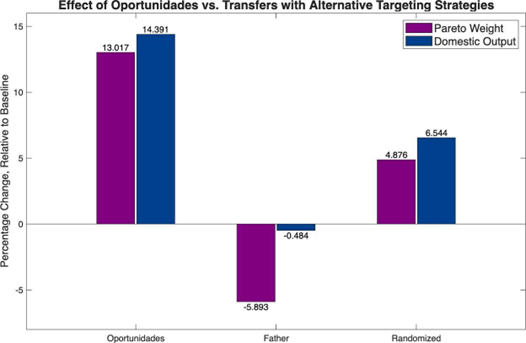
Notes: The figure compares the effects of Oportunidades to the ones of counterfactual policies that adopt alternative targeting strategies for cash transfers (targeting to fathers vs. randomising the identity of the recipient).
Furthermore, Figure 2 shows that targeting wage subsidies to mothers have a similar effect on their bargaining position and domestic production. Nonetheless, for the effect to be comparable to the one documented for Oportunidades, the subsidy needs to be almost 40%.
Figure 2: Effects of counterfactual wage subsidies
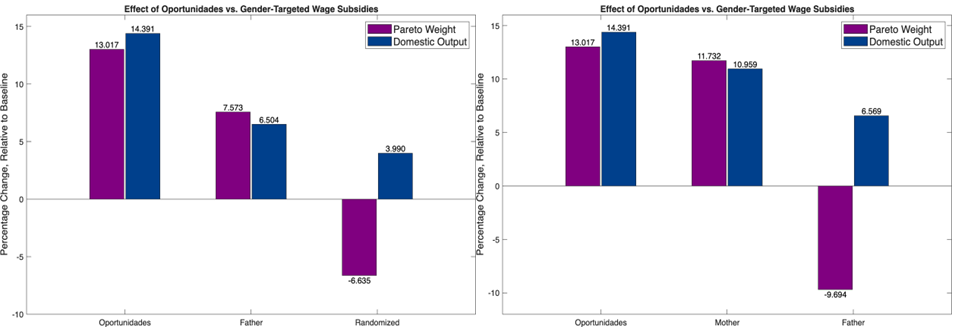
Notes: The first panel considers a wage subsidy of 25% targeted at mothers (second set of bars) and targeted at fathers (third set of bars). The third row considers a wage subsidy of 40% targeted at mothers (second set of bars) and targeted at fathers (third set of bars).
Policy implications for targeting cash transfers
Targeting cash transfers to women have a significant effect on their decision-making power. Importantly, there is also evidence that the income source targeted does not need to be limited to non-labour income only, but wage subsidies are also an effective source of empowerment within the context analysed in my research.
While my structural approach allows for the analysis of interesting counterfactual policies and my model is able to replicate the observed effects of the programme on household behaviour, extending the model to account for dynamic behaviour in the form of household separation and the possibility of domestic violence affecting the dynamic effects of these types of policies on the decision-making structure of beneficiary households could enrich the analysis. Furthermore, while the results are robust to including different types of households (including households in which mothers do not work in the labour market), the model extension that includes non-working models would benefit from fully endogenizing the work/no-work decision rather than relying on wage imputation. This extension would clarify the policy effects at both the intensive and extensive margins of labour supply.
References
Attanasio, O, and V Lechene (2002), "Tests of the income pooling in household decisions", Review of Economic Dynamics, 5(4): 720–748.
Blundell, R, P-A Chiappori, and C Meghir (2005), "Collective labor supply with children", Journal of Political Economy, 113(6): 1277–1306.
Cherchye, L, B De Rock, and F Vermeulen (2012), "Married with children: A collective labor supply model with detailed time use and intrahousehold expenditure information", American Economic Review, 102(7): 3377–3405.
Chiappori, P-A (1997), "Introducing household production in collective models of labor supply," Journal of Political Economy, 105(1): 191–209.
Doss, C (2013), "Intrahousehold bargaining and resource allocation in developing countries", The World Bank Research Observer, 28(1): 52–78.
Duflo, E (2012), "Women empowerment and economic development," Journal of Economic Literature, 50(4): 1051–1079.
Flores, A (2026), "Are cash transfers effective at empowering mothers? A structural evaluation of Mexico's Oportunidades," Review of Economics and Statistics, 1–45.
Parker, S W, and P E Todd (2017), "Conditional cash transfers: The case of Progresa/Oportunidades," Journal of Economic Literature, 55(3): 866–915.