




Evidence from Brazil shows that an air interdiction policy in 2004 shifted cocaine routes to rivers, increasing violence in Amazonian municipalities.
Editor’s note: For a broader synthesis of themes covered in this article, check out our VoxDevLit on Organised Crime.
Over the past two decades, the Brazilian Amazon has experienced a sharp rise in violence, diverging from national trends. Between 2000 and 2019, homicide rates in the region nearly doubled. The dominant view is that land conflicts and environmental crimes historically associated with the Amazon – such as illegal logging and mining – are the main drivers of the local dynamics of violence (Chimeli and Soares 2017, Fetzer and Marden 2017, Pereira and Pucci 2026). Yet recent evidence suggests that violence has also increased in areas where these activities are not traditionally prevalent (Soares et al. 2021).
At the same time, the Amazon basin has become an increasingly important corridor for cocaine trafficking, linking producing countries (Colombia, Peru, and Bolivia) to domestic and international consumer markets (Phillips and Collyns 2022, UNODC 2023). This shift suggests that changes in trafficking routes may help explain the recent rise in violence in remote parts of the Amazon.
In new work (Pereira, Pucci, and Soares 2026), we examine how an air interdiction policy in early 2000s Brazil shifted cocaine trafficking from air routes to Amazonian rivers, increasing violence in municipalities along these waterways. By raising the risks of aerial transport, the policy redirected trafficking to river networks, bringing criminal organisations into closer contact with local communities.
From air to river: A shift in trafficking routes
Until the early 2000s, the Brazilian government had relatively limited control over the Amazonian airspace. Drug traffickers relied on small aircrafts to transport cocaine across borders. River transport was less attractive due to longer travel times and higher logistical risks. Starting in 2002, the government significantly expanded air surveillance capacity through systems such as SIVAM-SIPAM (the Amazon Surveillance and Protection System) and CINDACTA IV (the Integrated Air Defense and Air Traffic Control Center for the Amazon region), aimed at improving air-traffic control and the detection of illegal flights. In 2004, with this infrastructure in place, Brazil introduced an interdiction policy to strengthen airspace control and address illicit cross-border activity.
Descriptive evidence suggests that these measures effectively disrupted airborne trafficking. Military expenditures on aircraft increased, reported plane interceptions became more frequent, and fuel consumption by small planes in the western Amazon declined. At the same time, cocaine seizures and overdose deaths rose in the region, suggesting increased drug circulation via alternative river routes. Taken together, these patterns point to a partial substitution from air to river transport. This shift likely increased traffickers’ physical presence in local communities, raising the risk of violence.
The Amazonian River network as a trafficking corridor
The Brazilian Amazon is crossed by a vast network of rivers that originate in the Andes and flow towards the Amazon River and the Atlantic Ocean. This network connects cocaine-producing countries directly to Manaus, a key logistical hub for both legal commerce and illicit trade.
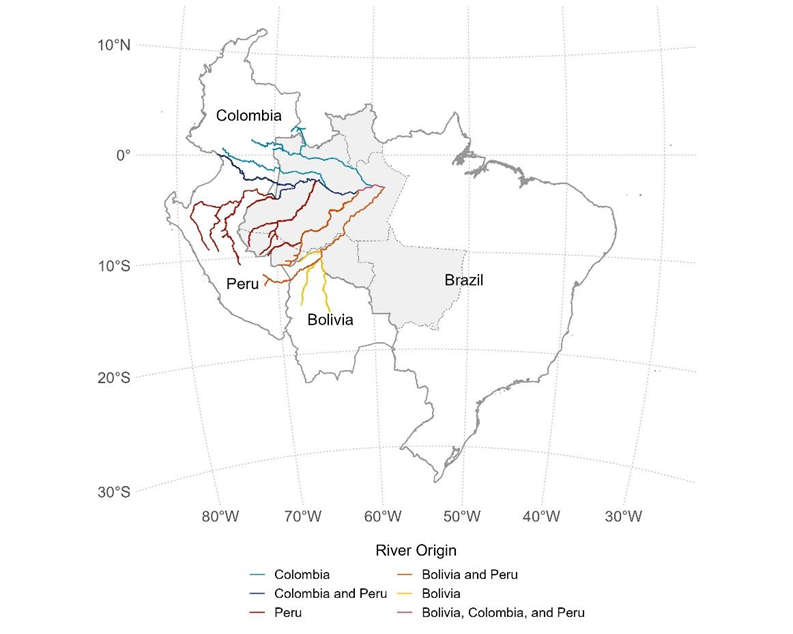
To study the impact of the air interdiction on violence along Amazonian river routes, we construct a measure of each municipality’s exposure to cocaine flows. We identify 16 major rivers that plausibly serve as trafficking routes, linking producing countries to downstream Brazilian municipalities. We classify municipalities according to whether they lie along these routes and, if so, which producing countries they are connected to.
We then combine this geographic information with annual data on cocaine production in Andean countries. The idea is straightforward: higher production in a source country increases the potential flow of cocaine along connected routes, raising exposure for municipalities downstream. Figure 1 shows the classification of Amazonian rivers in different routes.
Figure 1: Cocaine trafficking river routes and countries of origin
Our analysis focuses on municipalities with fewer than 100,000 inhabitants in the western Amazon. These areas are geographically closer to Andean borders and historically more isolated from major urban centres and road networks. As a result, they were relatively shielded from land conflicts and deforestation-related violence, which was more common in the eastern Amazon.
Linking drug flows to violence
We use a panel regression model to examine how homicide rates respond to changes in cocaine production, comparing municipalities with different levels of exposure before and after the introduction of air interdiction in 2004. The key question is whether municipalities located along river routes become more sensitive to upstream cocaine production once air trafficking was disrupted.
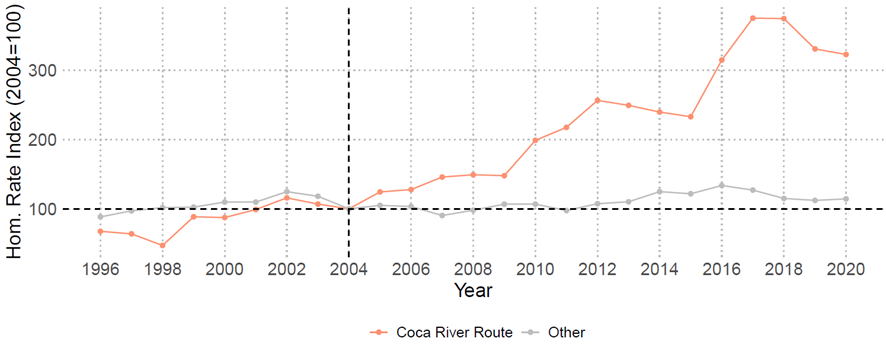
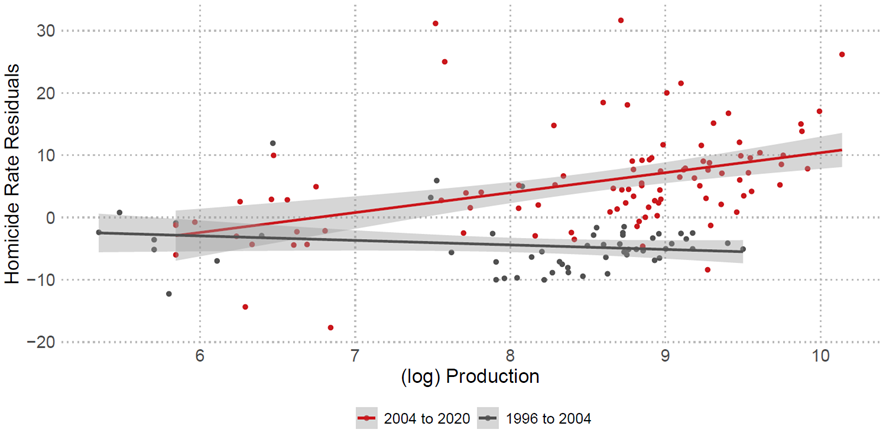
Figure 2 shows a clear pattern. After 2004, homicide rates rose significantly in municipalities along river routes relative to those outside these areas (Figure 2a). At the same time, violence along river routes originating from the Andes became more responsive to cocaine production in origin countries (Figure 2b). Before the policy (in grey), there was no systematic relationship between upstream production and local violence. After the policy (in red), violence in municipalities connected to cocaine producing regions became positively correlated with cocaine production. This pattern suggests that river networks became an active channel for drug trafficking, linking distant production shocks to local violence.
Figure 2: Homicide rate and cocaine exposure in West Amazon
(a) Homicide rate in cocaine river routes
(b) Correlation of homicide rate residuals and cocaine production in each route-year
Our estimates indicate that approximately 1,430 homicides recorded between 2005 and 2020 can be attributed to the displacement of cocaine trafficking caused by the air interdiction policy. This represents 27% of all homicides in municipalities located along river routes during the same period. Most of these homicides occur outside the home, involve firearms, and disproportionately affect young men. The impact is particularly pronounced among men aged 20 to 49, but there is also an increase in homicides among adolescents and young adults. In contrast, the data shows no significant rise in homicides related to land conflicts, suggesting that the effect is directly associated with drug trafficking.
Policy implications: The importance of displacement effects
These findings highlight the complexity of enforcement in illegal drug markets and the importance of accounting for spillover effects. Stricter enforcement can displace trafficking not only across routes but also across modes of transportation. In our context, improved airspace monitoring prompted traffickers to shift from air to river transport. This demonstrates how resourceful criminal networks can be in rapidly adapting to a completely different mode of transport. Different modes of transportation, in turn, can have very different socioeconomic implications because they entail different levels of contact with and involvement of local populations.
While we do not conduct a cost-benefit analysis of the policy, our results underscore the need for policymakers to anticipate the possibility of such displacements, and their broader consequences, when designing large-scale enforcement interventions. Without such considerations, interventions may simply relocate crime rather than reduce it and may worsen outcomes in vulnerable areas.
In this context, addressing the challenges currently faced in the Amazon requires a more integrated response. As trafficking shifts to river networks, it is essential to strengthen monitoring along these routes by using technologies such as drones and mobile radar, and by improving coordination across enforcement agencies. At the same time, reducing the likelihood that local communities engage in illicit activities requires policies that lower vulnerability, including expanded access to education, job training, and sustainable economic opportunities, such as those linked to the bioeconomy. Finally, given that cocaine supply chains are transnational, closer cooperation with neighbouring Andean countries is critical, particularly through improved information sharing and coordinated enforcement.
References
Chimeli, A B, and R R Soares (2017), "The use of violence in illegal markets: Evidence from mahogany trade in the Brazilian Amazon," American Economic Journal: Applied Economics, 9(4): 30–57.
Fetzer, T, and S Marden (2017), "Take what you can: Property rights, contestability and conflict," Economic Journal, 127(601): 757–783.
Pereira, L, and R Pucci (2026), "A tale of gold and blood: The consequences of market deregulation on local violence," Journal of Public Economics, 253: 105559.
Pereira, L, R Pucci, and R R Soares (2026), "Landing on water: Air interdiction, drug-trafficking displacement, and violence in the Brazilian Amazon," American Economic Journal: Applied Economics, forthcoming.
Phillips, T, and D Collyns (2022), "Police losing narco war in deadly Amazon region where duo disappeared," The Guardian.
Soares, R R, L Pereira, and R Pucci (2021), "Ilegalidade e violência na Amazônia," Amazônia 2030 Technical Report.
UNODC (2023), "Global report on cocaine 2023: Local dynamics, global challenges," Technical report.