






After a Bangladesh factory fired workers following labour unrest, survivors who lost friends quietly cut output and quality to punish management.
Editor’s note: The authors have made slides available here.
Industrialisation is seen as a key component of the development process (Lewis 1954, Rodrik 2013), but it comes with challenges – not least labour disputes (Boudreau 2024). For example, in July 2012, workers at the Maruti Suzuki plant in Manesar, India set part of the factory ablaze and injured nearly 100 managers (Prasad 2012). Strikes, walkouts, and violent confrontations are common across the fast-growing manufacturing sectors of emerging manufacturing powerhouses like Bangladesh, China, India, and Vietnam, and often end the same way: management lays off a large share of the workforce to restore order.
Whether layoffs work is unclear. Removing disruptive workers could intimidate those who remain and raise their productivity. But it might also backfire, sapping morale or provoking retaliation among the workers who keep their jobs. Earlier work hints at the downside: Krueger and Mas (2004) show that labour strife at a Bridgestone/Firestone plant coincided with a surge in defective tyres, and a large management literature finds that “layoff survivors” who identify with dismissed colleagues and view the layoff as unfair react most negatively (Brockner et al. 1987). Yet evidence on what happens to the people who stay has been scarce, because researchers rarely gain access to firms during conflict and individual productivity is difficult to measure.
Insights from a garment factory in Bangladesh
We were able to look inside one such episode (Akerlof, Ashraf, Macchiavello, and Rabbani 2026). We had begun working with a large Bangladeshi sweater factory – one of the country’s biggest knitwear exporters – to study worker productivity when unrest unexpectedly broke out. After workers in the Manual Knitting Section of the factory protested over piece rates and the protest turned violent, management shut the section and fired 101 of its 406 operators for their alleged role in the violence.
This setting is well suited to measurement: each worker operates their own machine at a fixed location, knitting sweaters alone and is paid by the piece, so we can track each person’s output month by month and compare it across workers while adjusting for how complex each sweater is. Combining these records with ethnographic observation and a social-network survey – an “insider econometrics” approach (Ichniowski and Shaw 2009) – we see not just how much output fell, but who was affected and why.
The aggregate change in output was large. Comparing output from the section before and after the layoffs, we find that daily output in the six months following the layoffs was about a quarter lower than a year earlier. Most of the drop – around two-thirds – came from surviving workers simply producing less.
A persistent drop, concentrated among workers who lost friends
Why would survivors slow down? Our key insight is that the productivity drop depends on which co-workers a survivor lost in the layoffs – not simply how many. From watching the floor and surveying workers, we learned that workers form social connections with their co-workers, and these form along predictable lines: workers socialise mainly with peers in their own supervisory ‘block’ or administrative groups. Within these blocks, they socialise more with those seated physically close. We used these patterns to gauge, for each surviving worker, how many friends they likely lost to the firings and how this is associated with productivity changes before and after the layoffs.
The result is striking. Workers who lost more friends cut their output sharply compared to those who lost few. The magnitude is sizeable: each friend lost translates into roughly two to three days of lost output per month. Because workers are paid piece rates, this is lost income for them as much as lost production for the factory.
Crucially, the drop was not short-lived. As Figure 1 shows, output moved in step across more- and less-affected workers before the firings and then fell abruptly afterwards, persisting largely undiminished for months and only fading after about half a year.
Figure 1: Output before and after the layoffs, by exposure to the firing of friends
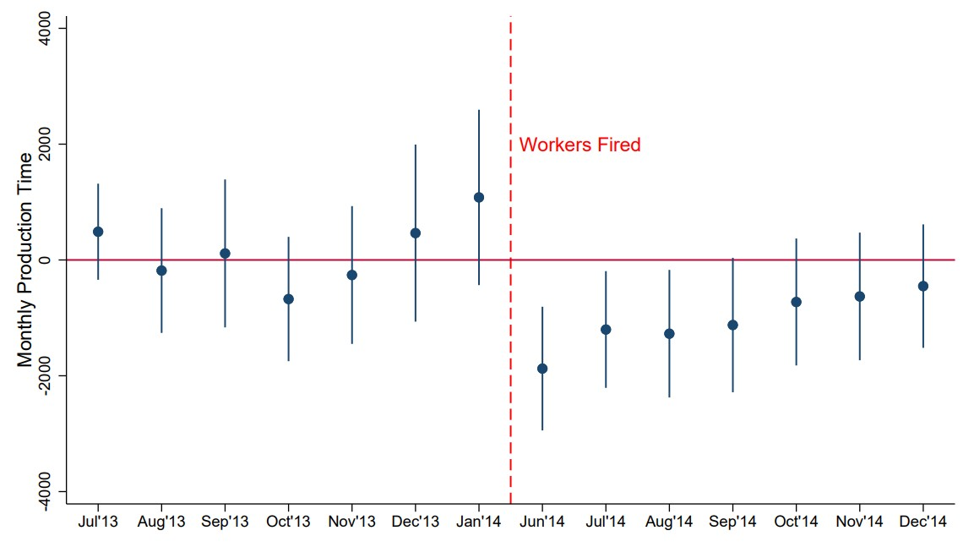
Notes: Each point shows how a worker’s monthly output changed for those more exposed to the firing of friends relative to those who were less exposed. Output tracks closely before the firings (no divergence), then drops sharply afterwards and recovers only gradually. The estimates suggest that one standard deviation higher exposure to firing leads to about 11% decrease in monthly production per worker on average in the six months following the firing. Vertical bars are 95% confidence intervals. February–May 2014 are omitted as the section was disrupted or closed.
Next, we ask why losing friends made survivors slow down. One possibility is demoralisation from friends getting fired. Another is punishment – they deliberately held back to retaliate against the factory. Telling the two apart matters for understanding workers’ incentives and identifying policy responses. Yet it is inherently hard, since both are emotional responses we cannot observe directly. The factory's quality records nonetheless offer suggestive evidence. As part of regular operations of the factory, sweaters with minor flaws are sent to separate ‘mending’ operators at no cost to the worker; sweaters with serious ‘defects’ must be fixed by the worker himself, on their own time. A demoralised worker is likely to let both kinds of error rise. On the other hand, a worker trying to punish the firm would allow the mending flaws to rise, which only cost the factory, while avoiding defects, which cost himself.
That is exactly what we find: among the most affected workers, mending flaws jumped after the firings while defects did not. The pattern is difficult to reconcile with simple demoralisation and points instead to a deliberate, strategic withdrawal of effort aimed at management. Tellingly, the factory appears to have understood this. Rather than raise piece rates across the board, it quietly steered more lucrative styles (those that pay more for each minute of work) towards the most aggrieved workers – and as it did, mending flaws subsided and productivity recovered.
Together, the findings paint the workplace as a web of relationships held together by social ties, where severing those ties carries a real and lasting price.
Efficiency wages
Such episodes also speak to long-standing questions about the determinants of efficiency wages. A central strand of that literature – the gift-exchange view – holds that workers reciprocate fair treatment with effort and repay perceived mistreatment by withdrawing it (Akerlof 1982). What the sweater factory reveals is that this exchange is not confined to the worker upon whom the firm acts. When management fired the alleged troublemakers, the workers who slowed down were not those who had been punished but their friends who remained – survivors responding to how someone else had been treated. How a firm treats one worker, in other words, affects not only that worker's productivity but the productivity of others connected to him.
This carries an important implication for how we think about efficiency wages. The implicit contract between firm and worker is usually modelled as bilateral: the firm offers a worker a wage above the market-clearing level, and the worker repays it with effort. But if mistreating one worker provokes a response from their friends and the rest of their social circle, the relationship is better understood as multilateral – an understanding between the firm and the workforce as a whole rather than a bundle of separate, private deals. This structure helps explain why efficiency wages can be large. A firm contemplating shabby treatment of one worker is not weighing that single worker's reduced effort against the saving; it must reckon with the response of everyone who would take the slight personally. When the cost of unfairness is multiplied across a social network, the premium a firm must pay – and the restraint it must show – to keep effort high is correspondingly greater.
Implications for labour policy
For policymakers and managers in developing countries, the central lesson is that mass layoffs used to quell unrest can be self-defeating. The cost may not always be visible immediately; it may show up later as quieter machines among the very workers the firm chose to keep. Because the mechanism is social, the harm is hard to anticipate from headcounts alone.
This strengthens the case for institutions that let workers raise grievances before they boil over. Functioning unions or worker committees can commit firms to treating workers fairly, heading off the disputes – and the costly layoffs – that follow. Evidence from Myanmar shows that union leaders can help workers coordinate well for labour movements (Boudreau et al. 2025). In settings where collective representation is weak or repressed – as across much of the garment sector in Bangladesh – building credible channels for worker voice may be both a social and a commercial investment.
References
Akerlof, G A (1982), "Labor contracts as partial gift exchange," Quarterly Journal of Economics, 97(4): 543–569.
Akerlof, R, A Ashraf, R Macchiavello, and A Rabbani (2026), "Unrest, layoffs, and productivity at a Bangladeshi sweater factory," Journal of the European Economic Association, jvag017.
Boudreau, L (2024), "Multinational enforcement of labor law: Experimental evidence on strengthening occupational safety and health committees," Econometrica, 92(4): 1269–1308.
Boudreau, L, R Macchiavello, V Minni, and M Tanaka (2025), "Leaders in social movements: Evidence from unions in Myanmar," American Economic Review, 115(6): 1975–2000.
Brockner, J, S Grover, T Reed, R DeWitt, and M O'Malley (1987), "Survivors' reactions to layoffs: We get by with a little help for our friends," Administrative Science Quarterly, 32(4): 526–542.
Ichniowski, C, and K L Shaw (2009), "Insider econometrics: Empirical studies of how management matters," NBER Working Paper No. 15618.
Lewis, W A (1954), "Economic development with unlimited supplies of labour," Manchester School, 22: 139–191.
Krueger, A B, and A Mas (2004), "Strikes, scabs and tread separations: Labor strife and the production of defective Bridgestone/Firestone tires," Journal of Political Economy, 112(2): 253–289.
Prasad, S N (2012), "Case study: Labour unrest at Manesar Plant of Maruti Suzuki in 2012," Cases in Management.
Rodrik, D (2013), "Unconditional convergence in manufacturing," Quarterly Journal of Economics, 128(1): 165–204.